Hambledon – the cradle of two revolutions

July 30, 2017

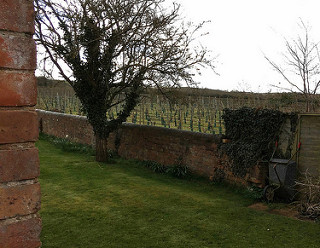
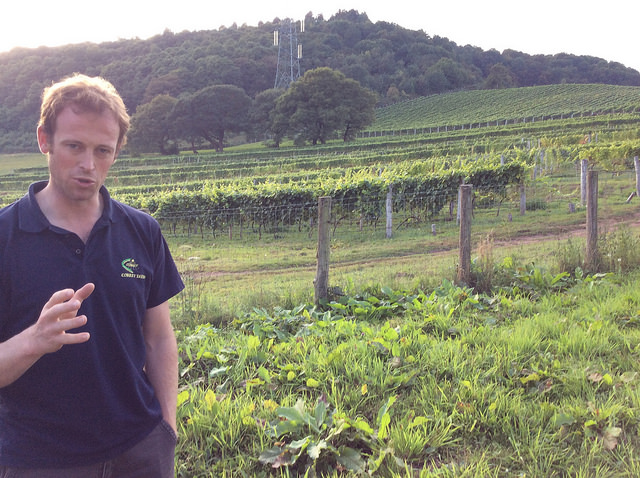
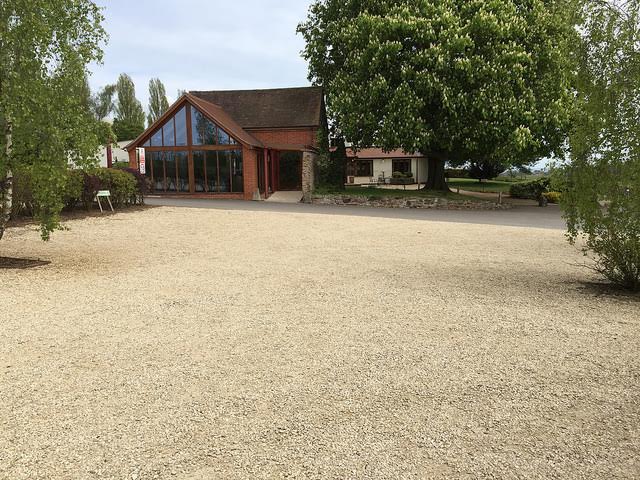
IF YOU gaze from the steps of this country house in Hampshire towards the horizon it just looks like another vineyard. True, a very attractive vista with the Chardonnay grapes in the foreground subtly changing hue as they merge into lines of Pinot Noir and then at the far end Pinot Meunier – the classic Champagne varieties.
But this is no ordinary vineyard. It is the actual sanctified ground  at Hambledon where Sir Guy Salisbury Jones planted England’s first commercial vineyard back in 1951. The original plantings were of hardy Germanic vines such as Seyval though he later planted all three Champagne vines as well and experimented with sparkling though not on a commercial scale. The original label had cricket stumps on it – a homage to Hambledon as the place where the game of cricket started. A nearby(ish) pub, the Bat and Ball, is a shrine to its birthplace.
He little realised that thanks to his pioneering efforts Hambledon was to become the cradle of a second revolution – proving that wine could be made in England on a commercial scale. To be fair, Wales – so often underrated in viticultural terms – had planted Britain’s first commercial vineyard under the Scottish Earl of Bute more than 50 years previously at Castle Coch near Cardiff.  Unlike Hambledon, it had not provided the inspiration for dozens of other vineyards to follow suit.
What was the wine like? It is easy to dismiss these early English efforts as being a bit amateurish but the 1971 listing of the very choosey Wine Society said that considering the vagaries of the English weather Hambledon’s wine was “astoundingly good”. That is a phrase that I have rarely if ever seen used to describe any wine. I wonder if this was the Hambledon wine served in May of the following year at a banquet in Paris. It was hosted by Queen Elizabeth for President Pompidou – as part of the thaw in Anglo-French relations that led to Britain’s entry into the European Common Market a year later. What President Pompidou thought of it is not on record.

Since those pioneering days the estate of Hambledon has been on a Cooks’ Tour of different owners. But now it is in the very capable and even visionary hands of Ian Kellet, an investment banker from the north of England, who has raised the quality of the crop – now all sparkling wine – to levels undreamed of by Sir Guy – as the photos on the wall of three consecutive gold medals at the International Wine Challenge testify.
Nor is he sitting still. He already has what is claimed to be the country’s first gravity-fed grape pressing system where the grapes are taken to the top of the winery to find their own way down without intervention through the presses before being sorted into four qualities only two of which are used for wine the rest being turned into brandy. His long-term plans include producing a million bottles of fizz and an underground cave which he is about to excavate through the chalk terrain that could have a capacity for 2 million bottles.
I have visited dozens of vineyards in England and Wales since I started writing about English and Welshwines some years ago and Hambledon has always been one that I was really looking forward to. I was not disappointed. Hambledon is now among England’s super vineyards which are giving  the champagne houses such a run for their money. And the wines which we sampled? Totally delicious.

Follow me on @BritishWino

The Bat and Ball

Glowing review from the Wine Society 1971
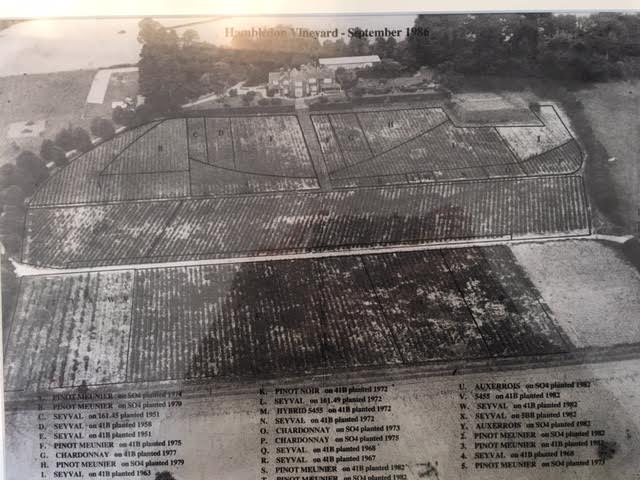
 

Original Salisbury Jones layout (photo Hambledon vineyard)


Shakespeare’s vineyards . . . (well sort of)

April 13, 2016

Welcombe1 Welcombe left

Bearley1 Bearley below

AS IT IS the 400th anniversary of Shakespeare’s birth this month I decided as part of our annual pilgrimage to Stratford-upon-Avon to ponder whether there were any links between Shakespeare and vineyards. Stratford today boasts two vineyards Welcombe Hills (one acre) and Bearley (three acres) in the Snitterfield area less than four miles from the town centre. Both of them are behind houses on the main road, a sling’s throw from a patch of land between Smith’s Lane and Bell Lane known to have been owned by Shakespeare’s grandfather, Richard where Shakespeare’s father was born.
Bearley sells a very drinkable wine – made from the Rondo and Regent grapes – called, wait for it, “Bard’s Red”. It claims further links with Shakespeare’s family because Mary Arden, Shakespeare’s mother, lived in the neighbouring village of Wilmcote. Her house has been turned into a living Tudor farm. Among the delights on offer is to be present at a typical Tudor lunch. Welcombe, claims similar links and recently has been under the management of Kieron Atkinson who also looks after Renishaw Hall in Derbyshire.
If you walk around Stratford itself you are are rarely more than a few yards from something claiming a link with Shakespeare from the “The Food of Love” shop to the Othello taxi service. But as I intended to explore vineyards and wine I was particularly interested in the claims of the taverns. The boldest is that of The Vintner, situated a short walk from Shakespeare’s home at New Place, which, having traced its ancestry back to 1600 when John Smith and his wife traded there, adds: “It is more than likely that William Shakespeare purchased his wine from here!” Well, after allowing for the fact that there is no documentary evidence that Shakespeare ever drank wine let alone bought any here, this is nevertheless almost as likely as the presumption that he went to the local grammar school for which there is also no documented evidence though it is highly likely to be true. A similar claim might be made by the Garrick, very close to New Place. It could even be the tavern where Shakespeare is believed to have had a last drink with his literary mates Ben Jonson and Michael Drayton from which he contracted a fever, dying shortly afterwards. The Garrick – renamed later after the great actor – claims to have been serving real ale on its premises since at least 1594. There is also the venerable The Old Thatch Tavern, 300 yards from William’s birthplace, which dates back to 1470 and claims to be the oldest pub in Stratford.
What would be have been drinking? If he put his own tastes into those of his characters such as Sir John Falstaff then his drink of choice would have been Sack (mentioned over 50 times in the works) which is a kind of Sherry or perhaps Canary or even Malmsey (a kind of Madeira) which was Shakespeare’s drink of choice when he allowed Richard 111 to drown his brother the Duke of Clarence in a cask of the stuff.


How far north can a vineyard go?

December 2, 2015
Norway1

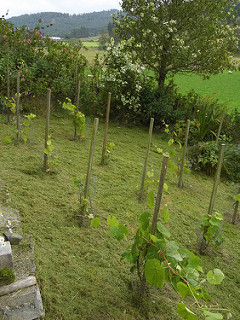
Vines on a gentle slope in Norway


JOAR SAETTEM produced “a nice floral wine” from the Solaris grape in 2014. Nothing particularly remarkable about that. Except that it was grown at Lerkekasa in Norway on latitude 59.4 in what is claimed to be the most northerly vineyard in the world. It sits on land rich in minerals with plenty of sun and reflected light from nearby Lake Norsjø.

This is the most extreme example of vineyards moving North, a trend that is taking hold in England as well as in Sweden and Denmark – though they are all considerably further south than Lerkekasa. Viticultural pioneers are taking a bet that global warming is on the way even though it involves a constant battle against the elements. This northern march has plenty of lessons for the whole of Britain as new vineyards move steadily up country to take advantage of improved techniques, hardier varieties and the challenge of the unknown.

The Solaris grape – hardly a household name in the south – seems to be becoming the grape of choice to make white wines in these pioneering cool and cold-climate vineyards in England, Scotland and North Wales.

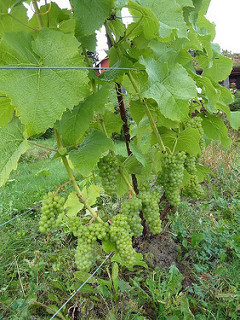
The Solaris grape growing in Norway


Norway may be setting the pace but on my reckoning (corrections welcome) three of the next four most northerly vineyards after Lerkekåsa are in Scotland and not in Scandinavia.

The most bizarre – to southerners – is Polycroft on the remote Isle of Lewis in the Outer Hebrides – on 58 degrees latitude (the higher the latitude, of course, the further north). It grows mainly Black Hamburg grapes in polytunnels for sale at local markets in Stornaway but also makes a wine which is distributed to family and friends. The proprietors Donald Hope,a former missionary, and his wife Jean have no comment to make on the quality of their main wine, rosé. They are teetotal.


ScotlandAlanSmith1

Alan Smith’s experimental vineyard at Glenkindle, Scotland

Further south, but still pretty far north, on latitude 57, Alan Smith has a southern facing slope 800 feet at Glenkindle – it means “dale of roses” – on the eastern side of the Cairngorms National Park where he has established a small private experimental vineyard (picture, right) to explore the hardiest grapes that can be grown in Britain. The fashionable Rondo (red) and Solaris (white) are not hardy enough for these parts so he uses Baltic and Russian hybrids such as Dalnivostock Ramming and Jublienka Novgoroda. He doesn’t think global warming is that important because, he says, a lot of the plant types that grow in the south of England also grow at 57 degrees north though the varieties are different.

He has about 200 vines spread among greenhouses (for table grapes), pots, a polytunnel (for wine) and two areas for outdoor vines.  He hopes to produce his first bottles of wine next year. His progress is likely to be watched carefully by grape aficionados for one very good reason. Glenkindle is on the same latitude as the Great Glen and Loch Ness which Professor Richard C Selley in his influential book The Winelands of Britain has predicted will be an ideal geological structure to plant vines in the future if global warming continues. Maybe, one day, there will be the equivalent of a gold rush for land in the Great Glen – but not yet.

All of this leaves unchallenged the claim of UKvine’s esteemed food columnist Christopher Trotter to have made Scotland’s first wine on a proper basis at his Momentum vineyard at Upper Largo in Fife on latitude 56. This year he produced the first bottles of Chateau Largo with the Solaris grape which accounts for 75% of the 200 vines he has planted so far. He is honest and wise enough to say that he is unhappy with his first vintage and won’t share it yet – not even with a fellow columnist. But he believes he has learned from his mistakes and hopes eventually to raise money to plant over two hectares.

Scotland is no stranger to viticultural success. In Victorian times William Thomson established Clovenfords Vineries in 1870 and planted five acres of vines under glass, with miles of hot pipes to maintain the right temperature. It created a thriving business in table grapes for 90 years under four generations of the family until a collapse in the world price of grapes put paid to the experiment. High point? While working for the Duke of Buccleuch, William entered grapes into a competition in Paris for the Grand Gold Medal of the Central Society of Horticulture of France. And guess what? He won and, to the consternation of the French who couldn’t believe that grapes grown in wild Scotland could challenge their Divine Right to viticulture, was handed the gold medal by the Emperor of France.

In England, Astley, a lovely secluded vineyard in Worcestershire, was for a long time deemed the most northerly UK vineyard before Renishaw Hall near Sheffied took over the mantle – but now there are over two dozen further north than Astley and they are winning prizes in international competitions. Ryedale at Westow near York in Yorkshire, on 53.9 latitude has ten acres and claims to be the most northerly commercial vineyard in Britain. No one in Scotland will argue with that – for the moment.

Rydedale makes most of its wine in its own winery and has won a string of bronze medals in international competitions plus a silver medal in United Kingdom Vineyards Association 2013 competition for its Shepherd’s Delight rosé. But pride of place for quality among Northern vineyards must go to Bill Hobson of Somerby Vineyard in Lincolnshire who won a gold medal at the 2014 English & Welsh Wine of the Year show for his – you’ve guessed it – Solaris still white.

Solaris slso featured in another stunning success for a Northern(ish) vineyard when Kerry Vale on the English/Welsh border at Pentreheyling in Shropshire, won one of only seven silver medals awarded to English vineyards for its Shropshire Lady dry white at the very prestigious International Wine Challenge 2015. It is a delicious wine and has become one of our favourites.

One could go on but the point is made. The success of British wines is moving slowly northwards thanks to improved techniques, climate changes and the unflappable enthusiasm of the British to produce wine from their own soil. Loch Ness, here we come.
Edited version of article in the current issue of UKvine (printed editions only)


Britain at its most picturesque – the Wye Valley wine trail

June 8, 2015
Parva1

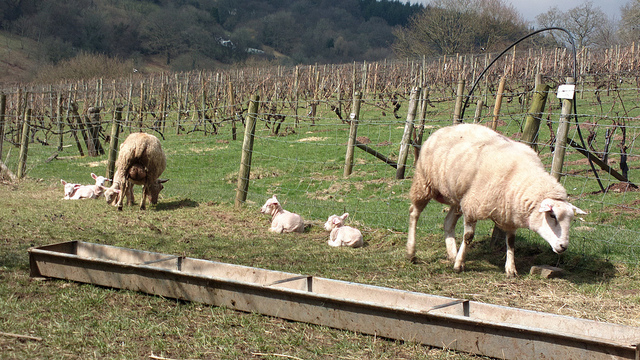
Sheep at Parva Farm vineyard in Tintern


THE WYE VALLEY has a strong claim to be the cradle of the tourism industry in Britain. When Continental wars deprived monied people of the Grand Tour in Europe they perforce turned homewards and the Wye Tour from Ross-on-Wye to Chepstow – passing Goodrich Castle and Tintern Abbey – became the trip to make for them and for poets like Wordsworth and Thomas Gray not to mention painters such as Turner.
It is almost the last place you would think of today as a vineyard destination. That is because we define our vineyards by county or pre- defined regions and can’t easily cope with a river haven like the Wye Valley which transcends countries – Wales and England – as well as counties (Gloucestershire, Monmouthshire and Herefordshire). But today it has a strong claim to be a vineyard destination as well.
Travelling up the Wye from Chepstow the first vineyard you come to is Parva Farm on the left of the river (open all year) stunningly situated up a steep slope in Tintern overlooking the river and, if you reach high enough, the Abbey.  Its wines have won a stack of silver and bronze medals. Marks and Spencer recently asked for as much of its Bacchus as they could spare.
A few miles up river at Monmouth you can visit Ancre Hill Estate (April to end September) a biodynamic vineyard which burst on to the scene two years ago when its 2008 (Seyval) white was voted the best sparkling wine in the world at the Bollicine del Mondo in Verona beating off competition from established champagnes. This was an astonishing achievement for a new Welsh vineyard which even my Welsh friends have difficulty in believing.  On a sunny day eating a lunch of their local cheeses, vines stretching out before you, with one of their lovely sparkling or still wines (Pinot Noir, Chardonnay etc) is a great joy.
Further upstream at Coughton, near Ross-on-Wye, on the site of a Roman vineyard, is newcomer Castle Brook whose delicious Chinn-Chinn 2009, made with classic champagne grapes, recently won a gold medal and was voted the best sparkling white in the whole of the South-West Vineyard Association’s area beating off the likes of Camel Valley in Cornwall and Furleigh in Dorset. Castle Brook is owned by the Chinn family, probably the biggest asparagus growers in the country. It is open by appointment but wine can be purchased online.

CastleBrook

Christopher Chinn of the Chinn family who have diversified from asparagus into sparkling wines

Further north, less than ten miles from the Wye with a good restaurant and accommodation is the highly regarded Three Choirs whose 80 acres produce fine prize-winning wines, including gold. The vineyard also makes wine for dozens of other vineyards. If you take into account the whole vineyard experience – including the quality of wine, the setting, the food and the atmosphere, this one is up with the very best.

ThreeChoirs

Three Choirs, one of Britain’s oldest and most successful vineyards

Strawberry Hill

Banana trees at Strawberry Hill

Strawberry Hill vineyard, so close to Three Choirs that you could almost use it as a spittoon, is one of the most unusual vineyards anywhere and one of my favourites.  It makes good wines (some stocked by Waitrose) partly from over an acre under glass enabling it to grow Merlot and Cabernet Sauvignon  not normally possible in England.
It claims to be the only vineyard in the world growing commercially under glass, which no one has yet contested. As if that isn’t enough, it  has rows of flourishing banana trees – growing outside! – as well.

There are plenty of other vineyards in The Wye Valley (depending on where you draw the boundaries) including a new 3.5 acre one at Wythall in the grounds of a stunning Tudor mansion, Lullham, the wonderful Broadfield Court, also Coddington,  now under happy new ownership, Sparchall and a micro vineyard The Beeches at  Upton Bishop. This is by no means a complete list. If all these can’t generate a vineyard trail I don’t know what will. If Wordsworth were alive today, I wonder if he would have  written about Wines  a few miles above Tintern Abbey rather than  his celebrated “Lines written a few miles above Tintern Abbey” .Either way Galileo’s description of wine as sunlight held together by water has a unique resonance in the Wye Valley.


The road to app-iness for Britain’s vineyards

December 31, 2014

Britain’s rarest vineyard at Strawberry Hill, Glocs, has an acre under glass and banana trees


OK, it’s a new year and English and Welsh vineyards are on a roll. The challenging question is can this upsurge in popular interest be turned into a community of producers and consumers that would be mutually beneficial. One obvious route is to create a smartphone app that tells imbibers and tourists where the nearest vineyards are complete with directions how to get there and access to social networks to see what others think about the vines and wines.
There is no shortage of wine apps. I have a couple of dozen on my iPhone, about half a dozen of which I use regularly. Some, like the excellent ones from Berry Brothers and the Wine Society, enable you to search their corporate archives and buy directly from the phone if you want to. Berry Brothers even have educational videos. But they are mainly about imported wines.
If you want to employ some of the more exciting functions of a mobile phone – like identifying a wine from its label and telling you how much it costs – you will have to use an overseas app (mainly American) such as WineSearcher, Vivino or Delectable. These are very handy if you want to know in a restaurant whether you are being charged three, four or even five times the retail value of the bottle – simply point and click at the label and the price pops up on your screen often with comments from other users.
If you want to know where British vineyards are you can use the excellent UK vineyards map at http://ukvineyards.co.uk/vineyards-map/southeast/ which works best from a desktop computer.


But if you are on the move and want to know where the nearest vineyards are complete with directions how to get there you will have to use an American app like Winerypedia which in theory works around the globe. I noticed when it started that Chapel Down was on to it pretty quickly. I put up a few vineyards myself and others also started appearing. It accepts user-generated content so could be used as a UK community. It is no where near comprehensive yet but it is worth looking at because it shows what can be done with simple GPS technology. And it’s free.
The only English app I know of promoting a range of vineyards is one that was due in December from the South East Vineyard Association which represents many of the most successful vineyards in the country. I paid £2.49 for it at the online Apple Store a few days ago though it seems to have been withdrawn since. Hopefully, this will be to change it because it looks like being a sadly lost opportunity.

Entries from the Delectable app

Although there are some elegant pictures with text you can get a better (free) map from the UK vineyards offering mentioned earlier. There doesn’t seem to be a facility to see how far you are from a vineyard let alone getting directions. One of the aims is to raise money for the Association by charging £2.49  – but this simply won’t happen. Apps like this are nearly always free because of an entrenched reluctance by consumers to pay. I deeply regret this fact but it is true. Punters expect all but the most specialised apps (Hugh Johnson may be able to get away with it) to be free leaving the publisher to make money by in-app purchases, adverts or upgrades later. A vineyard app is not an end in itself but a means to promoting vineyards and selling wine. That is where the returns – and the community – will come from. It has to be free upfront.
Wouldn’t it be nice if there was a community-based app that gave you live directions to the nearest vineyard and enabled you to add your own comments and ratings and see what others were saying about UK wines – complete of course with a buy-button.
Ideally, such an app would be independent of any vested interests as it would obviously contain criticism as well as praise (Think Trip Advisor). Failing that the UK Vineyards Association and English Wine Producers should get together and do it in their collective interest.
It is surely better that we do this ourselves rather than yet again hanging on the coat tails of the US?


For English sparkling . . and St George

October 27, 2014

It started off a few days ago as a bit of banter on Twitter but it would be a great shame if it ended up in the bottomless pit of unrequited tweets. The idea was – is? – that there should be an English Sparkling Wine Day. Like most ideas, it has multiple sources. I (@BritishWino) happened to be glancing at some tweets and was totally surprised to find  that it was #worldchampagneday. Without thinking I wrote: “Apparently it is #worldchampagneday today. Remind me when it is #EnglishSparklingDay. Did I miss it . .?”
Instead of becoming instant history as most tweets do, it was picked up by others including @abecketts,  @didier_pierson and EnglishWineJobs who urged that we should pick a date suggesting November to catch the Christmas rush. Others followed including  the redoubtable Stephen Skelton (@SpSkelton) who suggested April 23 which is not only St Georges Day but Shakespeare’s Birthday as well, a double celebration of England’s best. And we can make that a triple if we include our sparkling wine which has been winning gold medals all over the world yet is under-appreciated in its own country. That date seemed to find general favour.

England, of course, is not the only place in the UK producing excellent sparkling wine. There has been a strong revival in Wales where Ancre Hill of Monmouth has won top prizes in Italy and China as well as at home. But vineyards in England seem to want to market their wine as English Sparkling just as Wales is trying to create its own distinctive brand. Maybe Wales could do something similar on the same day or at a more appropriate time.  Or else the two countries could decide on another date such as the birthday of Christopher Merrett, the Gloucestershire inventor of what the French call the methode champenoise.

Paul Langham, chair of United Kingdom Vineyards Association at his aBecketts vineyard in Wiltshire

So what next? There is clearly a lot of mileage  in a day dedicated to English fizz. If properly marketed by individual vineyards and their trade bodies like The UK Vineyards Association and English Wine Producers it would give restaurants, pubs and off licences an opportunity to test the water, sorry, the wine without undue expense – especially if they were to promote it by the glass. As it is the first time it has been done it might attract media attention, not least, social media and there could perhaps be a prestigious lecture on the history and prospects for Albion’s fizz.
What do all you vineyards out there think? Do give your views through Twitter or  email me at victor.keegan@gmail.com and I will pass on your views – or post a comment below as I have now re-opened the comment slot in the hope it won’t be spammed out of existence again.

@BritishWino


Meet England’s new backgarden vineyards

October 17, 2014

MARKO BOJCUN is part of tiny workers’ co-operative vineyard called Hawkwood in Epping Forest, part of the OrganicLea community. This year he lost around 90% per cent of his own grapes to wandering deer and downy mildew. That’s the trouble with having a vineyard surrounded on three sides by trees. But his artisan winery also makes wine for 26 people in the neighbourhood who brought 375 kilos of grapes to him for processing. This is enough to make 250 bottles of wine which probably makes him the second largest of the new co-operatives in London after Chateau Tooting, the crowd-sourced experiment which I last wrote about here  which hopes to make 750 bottles compared with 662 last year.

Loading Chateau Tooting’s harvest en route to the winery

 In turn this could make Marko the third largest crowd-sourced winery in the country after Eden Vale in Cumbria – one of the most northernly vineyards in Britain. Eden hopes to produce 800 bottles this year – double last year – all from grapes grown in local greenhouses and conservatories. The increased quantity was thanks to a great response to an appeal for grapes in their local paper – a move which other budding co-ops may like to follow. They tell me that 650 of these bottles will be red (though so light it could be mistaken for rosé). At the moment it is not feasible to grow grapes outside so far north on a commercial scale . Angela and Ron Barker, the proprietors, admit that they will only get a pesky two bottles from their own (small) open air vineyard. But  if global warming continues then . . . watch this space.
The question is: are these three vineyards pioneers of a new trend that will spread around the country or just isolated examples of only local significance? None of them seem to have known of the others’ existence. They have all sprung up spontaeouusly in different places like mushrooms in a field. But in theory, they have a lot going for them. There is a resurgence of interest in UK wines buoyed up by global warming and increased technical ability. Lots of people have vines growing in their gardens and they soon get caught up in the romance of contributing to a wine partly made from their own grapes. Oh, and you don’t pay tax if it is for your own consumption.
Of course, the proof of the pudding is in the drinking. Imbibers, including myself, were quite surprised at the quality of Chateau Tooting’s product last year despite the fact that it was made from unknown grapes of varying sizes and quality from gardens across London which all had to be ready on the same day.
It is not only in GB. There is a resurgence of vine growing in the Paris area to complement the vineyard on the slopes of Montmartre which has been a tourist attraction for decades – but the price of land in central London and Paris rules out the prospect of large vineyards in the city centre.

Vineyard on the slopes of Montmartre in Paris

Forty Hall in Enfield from where you can see the Shard and Canary Wharf comes closest. However, space in gardens and allotments is a different matteer.  Patrice Bersac, president of L’association des Vignerons Réunis (the association of united Parisian and Ile de France winemakers) told the Daily Telegraph that the French authorities should take inspiration from Chateau Tooting’s iniitiative in London where grapes come from numerous gardens in the capital.

Meanwhile, I’d be very interested to hear about any wine cooperatives in the UK. If there are others it might make sense for them to create some sort of loosely run organsation where experiences can be exchanged.


From Forty Hall’s 10 acre vineyard in Enfield you can see the Shard and Canary Wharf


Moment of Truth for Britain’s booming vineyards . . .

September 19, 2014

Discussion time among the vineyard gurus

This year looks likely to be a record for vineyards in England and Wales – the second successive good year after a disastrous 2012. The question is what to do about it if, thanks to increased plantings and favourable weather, we are entering a period of surplus. So far premium sparkling wines, winning gold medals regularly have been very marketable but most vineyards exist by selling from the cellar door often at inflated – oops sorry – premium, prices because customers have been happy to pay extra for the novel experience.  I have encountered a lot of good wines as well as overpriced ones on my travels including sub-optimal English reds being sold for £20, £30 and even £50 to punters about to be hugely disappointed (including me . .). I have grown to love UK wines but they won’t be loved by the general public until prices come down a bit.
As vineyards enter the new era they will encounter not only the still prevalent psychological barrier among consumers (and merchants) against English and Welsh wine but the real barrier of price. Having spent a year drinking mainly UK wines and regularly asking dumb-struck restaurant waiters and bartenders for English and Welsh wines (unsuccessfully) I know the problem only too well. Maybe it is best summed by one gastropub owner saying: “There is no way I can pay more than £5 a bottle and hope to make a decent profit”.
So it was with great interest that I attended yesterday’s workshop organised by the UK Vineyards Association (UKVA) to map out a strategy for the future.
It was held in the beautiful 650-year-old Vintners’ Hall in the City of London where as you go in you pass a painting of a 17th century wine merchant Van Dorn who was famous for drinking four bottles of wine a day and looking none the worse for it, well in his painting.
Dozens of ideas were put into the pot including the need for strong governance, profitability, collaboration between growers, recognition of excellence, educating the young, a centralised web site, a single body to represent the industry, product placement, promotion by tourist boards, brand ambassadors, enforceable quality standards and sustainability (for profits as well as the environment) and so on.
There was a general feeling that the sparkling sector should develop its own personality and not ape Champagne. Instead of trying to dream up a single word “brand” everyone seemed happy to use “English Sparkling” not least because the word England is a strong selling point abroad – though Sussex likes the alliterative “Sussex Sparkling”.
 There are two big gaps. We are supposed to be living in the age of Big Data but neither the government nor the industry actually knows how may vineyards there are nor what current sales are. It is left to the redoubtable Stephen Skelton to estimate-  in the UKVA house magazine The Grape Press – that wine produced from UK vineyards in 2014 could reach 6.4 million bottles compared with a ten year average of 2.95m bottles. This sounds huge but UK production, with a good product to sell, still accounts for barely more than one per cent of the domestic market. Other industries would kill to be in that position.
 Where the industry has been painfully slow is producing an app for smart phones that could tell you how far you are from the nearest vineyard, opening times with “buy” buttons and also able to snap wine labels which are recognised and stored in a central database. The aim would be to produce a community of UK wine drinkers exchanging experiences. It turns out that vineyards in the south-west will soon have an app of their own and all credit to them. The problem is that it only works for the South-west when there should be one for the whole UK.  And, they are planning to charge £2.50 for it which, believe, me is a mistake as there is a huge reluctance to pay for this kind of app. It should have been free, funded by the vineyards who would get their payback from increased custom

That is but one example why the industry needs a single integrated entity to talk to government and the EU besides acquiring a funding mechanism through a bottle levy (discussed for years but never implemented) so the necessary investment can be made. I am a big fan of UK wines sparkling and still. Vineyards have a great opportunity to make a serious contribution to the UK economy – but they need to get their act together quickly not least by using increased output to lower prices. If they don’t do it the market will do it for them in a merciless manner.

Victor Keegan @BritishWino, @vickeegan


The vineyards of Herefordshire . . . Herefordshire ?

September 14, 2014

The historic vineyard at Castle Brook


HEREFORDSHIRE – where I spend a fair amount of time – could have been forgiven for feeling it had been dealt a raw hand by Bacchus. If only the county boundary line had been drawn a couple  of miles further out  in the south-west, it could have taken in the multi-gold winning Ancre Hill Estate in Monmouthshire. And if a few miles had been added on its north-east frontier  it would have bagged Three Choirs, one of England’s most successful operations.
Herefordshire, however, still has some interesting vineyards and could be at the start of a roll. While I was  researching this blog – an arduous task supping wine at every stop – it was announced by the South West Vineyards Association that Castle Brooks’s Chinn-Chinn 2009  had won gold and been voted the best sparkling wine in the South West, an area that includes a lot of very prestigious estates. It is probably the only wine that can get away with calling itself Chinn-Chinn because that is the family name. Chinn, who are also the biggest asparagus growers in the country, have lived here near Ross-on-Wye for centuries.  Wine is still a minor crop for them but, as I saw for myself, they take great care of their lovingly manicured five acres set in beautiful countryside in a historic part of the county which was mentioned in the Doomsday Book and used to be on the path of a Roman road.
Until Chinn-Chinn struck gold, Herefordshire’s main claim to fame was not quality but quantity. Sunnybank Vine Nursery in Rowlestone is the home of the National Collection of Vines with over 450 different types  – more than the rest of Britain’s vineyards put together.  I visited it yesterday on its annual Open Day  where owner Sarah Bell explained that the collection was under the watchful eye of Plant Heritage and was mainly aimed at enthusiastic amateurs who can buy cuttings or young vines for their own use. For easy growing and disease resistance she recommends Seyval for white wines  and Regent for red.

Broadfield Court


Broadfield Court (left) is one of the delights of the county, a charming country house  with 14 acres of vines and a cafe/restaurant where you can linger in the open air in summer with a snack or meal over a pleasant glass of wine (£3.50 a throw for their special reserve when I last paid a visit). It is the best all-round wine experience in the county.

But there are rivals kicking at its heels. Simon Day, who comes from the family that set up Three Choirs, recently bought the wine making equipment from Coddington vineyard in Colwall and has set it up in Ledbury where he will process Coddington’s wine  for the new owners while at the same time making wine from the  16Ridges vineyard in Worcestershire processing it in Herefordshire and selling it from the delightful Three Counties Cider Shop in the middle of Ledbury. Simon is also planning in the longer term to plant 20 to 25 acres (he has already done four acres) and to build a bigger winery. Watch this space.

Ledbury is not far from Frome Valley (below, right)), another delightfully situated vineyard  for which Simon Day is also turning the grapes into wine. It has a very pleasant entrance and tasting area in an old country house and sells a range of wines starting with a very quaffable Panton Medium Dry at a reasonable £7.50. James Cumming, who manages the vineyard also has a small one of his own in the West country.

Other Hereford vineyards include Lulham Court near Madley which  produces very pleasant wines(which can be purchased from the Coop in Newent)  from their three acres but at much higher prices that shown on their out-of-date web site. Beeches at Upton Bishop is a small vineyard run by John Boyd. Among others it supplies the neighbouring restaurant, the Moody Cow with its fine wine  while on the other side of Ross-on-Wye not far from Chinn Chinn Frank Myers and his wife Anthea Stratford McIntyre the European MP started a 3.5 acre vineyard three years ago in the gardens of their beautiful 17th century house and it will be another year or two before it is producing.

There are a number of other smaller vineyards which may grow bigger as Herefordshire stakes it claim in the amazing revival of the UK wine industry.

@BritishWino

Frome Valley


Open Day at the National Vine Collection


The grapes of Rath . . . Britain’s biggest vineyard takes shape

August 20, 2014


Rathfinny’s first grapes

IF YOU want to speculate about the future of English sparkling wine look no further than the soft undulating hills of Rathfinny Estate in east Sussex, the biggest gamble in the history of this nascent industry. It has already had more publicity than most of the rest of the UK’s 400 plus vineyards put together even though it has yet to produce its first glass of wine. On a flying visit yesterday I had to content myself with a glimpse of the first grapes (see above) and I had to walk quite a long way down the vineyard even to see those. Cameron Boucher, the highly experienced vineyard manager from New Zealand (below) says they have already planted 150 acres of the 400 planned which would make it the biggest vineyard in the UK and one of the biggest in Europe. He says the first of the smaller quantities of still wine will be produced next year, though it may not go out under the Rathfinny brand. It will be several years yet before its flagship sparkling has matured in bottle long enough to be released on to the market.


Cameron Boucher, vineyard manager


 Mark Driver, who left a lucrative job in the City to plough £10 millions of his own money into Rathfinny, is in danger of giving hedge funds a good name. He is nothing if not ambitious, planning to go from scratch to selling a million bottles of English sparkling against the established giants of Champagne about 90 miles across the channel who share the same chalky geological strata as Rathfinny.
Some people think he is barmy, others that he will usher in the next stage of the English (and Welsh) wine revival as it ups its game from a niche product to a serious industry. Having in my previous career as a journalist chronicled the remorseless decline of the UK’s manufacturing base over 40 years, I find it refreshing to observe a fledgling industry with such juicy prospects.
Of what other industry in Britain could it be said that it has a world-class product yet barely one per cent of its domestic market? Most of the wine produced in Britain is sparkling and we regularly win top honours. In the recent prestigious Champagne & Sparkling Wine World Championships England scooped 11 gold medals and 14 Silver, more than any other country except France.
Of course, it is not as simple as that. Vineyard guru Stephen Skelton (@spskelton) in his new book Wine Growing in Great Britain, points out that most of the growth in sparkling wine in the UK has come from Prosecco and Cava selling at well under £10 a bottle, a market that UK sparklers shy away from and that three quarters of Champange is sold at less than £20 a bottle which won’t leave much profit for low volume UK producers.
But, if warmer summers persist, a larger output could bring unit prices down in Britain and nowhere more than Rathfinny which stands to reap economies of scale as great as any in Champagne and on land that is considerably cheaper. But two things will be crucial to its success: it has to produce wine that wins top medals and – something manufacturing industry never had to contend with – it needs a succession of good summers.

English Wine Centre


 Before visiting Rathfinny we had our first trip to the long-established English Wine Centre at nearby Berwick  (left) which combines a shop selling a huge range of English (not yet Welsh) wines with lovely gardens, a hotel and a delightful restaurant serving a high standard of food which we enjoyed along with samplings of English wines of which the Nutbourne from West Sussex and Surrey Gold whites stood out for us.
We decided to walk there from Berwick station along the Vanguard Way, a picturesque path along the slope of the downs which brings you out a few hundred yards from the wine centre. We were late as it took us a while to figure out that the path went straight through the middle of a field of closely packed with seven feet high rows of sweet corn where GPS is of limited use.


Follow Victor Keegan on @BritishWino or @vickeegan

His London blog is LondonMyLondon.co.uk