
UK tables at the Real Wine Fair
.
.
.
.
.
I HAD some liquor today that was distilled in a house in Highgate using wormwood as an additive. It turned out it was all legit. Ian Hart and Hilary Whitney, who started in 2009, had to get four different licences before being authorised to set the operation up which distils its spirits under a vacuum in glassware. I stumbled across it at today’s Real Wine Fair at Tobacco Dock in London’s Docklands. I liked the the look of the bottles but said I was only really interested in English and Welsh wines. But when it was pointed out that three of the bottles were two thirds filled with wine from Three Choirs vineyard in Gloucestershire I was hooked and immediately sampled some Three Choirs based vermouths plus a cardamon gin and a Negroni, all marketed under the Sacred label.
The three English vineyards there – Ancre Hill, Davenport and Forty Hall – are all firm favourites with me as their new wines confirmed including a liimted edition 2015 Davenport Pet Nat with an 8.5% alcohol content and very pleasant Pinot Noirs from Ancre and Davenport. Forty Hall, the 10-acre community-run vineyard in Enfield, London had their impressive 2015 Ortega and Bacchus but none of their first sparkling wine which went mainly to sponsors and helpers. Future years will be different.
England and Wales represented barely two per cent of the vineyards on show – which gives some idea of the size of the fair which attracted wines from all over the world. Hundreds of people were there creating a real buzz along the lines of tables of all kinds of wines and artisan foods. Among those that grabbed me on a whet-my- whistle-stop tour was one from Priorat in Spain made from a vine over 100 years old, a 2015 Mtsvane Pet Nat from Georgia which was left in the bottle from primary fermentation and a Loxarel from Penedès in Spain that had been laid sur latte for 10 years without even being disgorged.
There is clearly a big market for “natural” wines. Some of the people I spoke to said that after drinking natural ones they couldn’t face the additives present in the usual varieties which they noticed in a way they hadn’t before. You don’t have to go all the way with the niceties of making organic and biodynamic wines to accept that they are making some very fine wines. The proof of the theory is in the drinking.
The proof of “real” wines is in the drinking
April 17, 2016
 Leave a Comment » |
  Uncategorized | Tagged: ancre hill, Davenport, english wine, fair, Forty Hall, real wine |
  Permalink
 Posted by shakespearesmonkey
Shakespeare’s vineyards . . . (well sort of)
April 13, 2016 Welcombe left
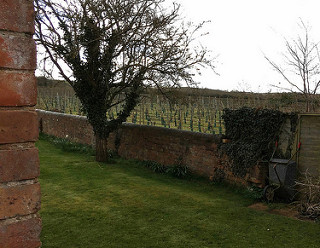 Bearley below
AS IT IS the 400th anniversary of Shakespeare’s birth this month I decided as part of our annual pilgrimage to Stratford-upon-Avon to ponder whether there were any links between Shakespeare and vineyards. Stratford today boasts two vineyards Welcombe Hills (one acre) and Bearley (three acres) in the Snitterfield area less than four miles from the town centre. Both of them are behind houses on the main road, a sling’s throw from a patch of land between Smith’s Lane and Bell Lane known to have been owned by Shakespeare’s grandfather, Richard where Shakespeare’s father was born.
Bearley sells a very drinkable wine – made from the Rondo and Regent grapes – called, wait for it, “Bard’s Red”. It claims further links with Shakespeare’s family because Mary Arden, Shakespeare’s mother, lived in the neighbouring village of Wilmcote. Her house has been turned into a living Tudor farm. Among the delights on offer is to be present at a typical Tudor lunch. Welcombe, claims similar links and recently has been under the management of Kieron Atkinson who also looks after Renishaw Hall in Derbyshire.
If you walk around Stratford itself you are are rarely more than a few yards from something claiming a link with Shakespeare from the “The Food of Love” shop to the Othello taxi service. But as I intended to explore vineyards and wine I was particularly interested in the claims of the taverns. The boldest is that of The Vintner, situated a short walk from Shakespeare’s home at New Place, which, having traced its ancestry back to 1600 when John Smith and his wife traded there, adds: “It is more than likely that William Shakespeare purchased his wine from here!” Well, after allowing for the fact that there is no documentary evidence that Shakespeare ever drank wine let alone bought any here, this is nevertheless almost as likely as the presumption that he went to the local grammar school for which there is also no documented evidence though it is highly likely to be true. A similar claim might be made by the Garrick, very close to New Place. It could even be the tavern where Shakespeare is believed to have had a last drink with his literary mates Ben Jonson and Michael Drayton from which he contracted a fever, dying shortly afterwards. The Garrick – renamed later after the great actor – claims to have been serving real ale on its premises since at least 1594. There is also the venerable The Old Thatch Tavern, 300 yards from William’s birthplace, which dates back to 1470 and claims to be the oldest pub in Stratford.
What would be have been drinking? If he put his own tastes into those of his characters such as Sir John Falstaff then his drink of choice would have been Sack (mentioned over 50 times in the works) which is a kind of Sherry or perhaps Canary or even Malmsey (a kind of Madeira) which was Shakespeare’s drink of choice when he allowed Richard 111 to drown his brother the Duke of Clarence in a cask of the stuff.
Leave a Comment » | Engilsh vineyards | Tagged: Bearley, Ben Jonson, Falstaff, Shakespeare, Snitterfield, stratfor-upon-avon, stratford, Welcombe, Wilmcote | Permalink
Posted by shakespearesmonkey
How bad are your tastebuds?
March 28, 2016 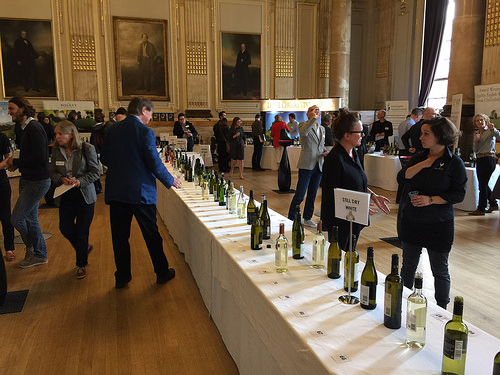
A London wine tasting
I RECENTLY attended a fascinating lecture on the chemistry of tastebuds at University College London (Department of Chemistry). During the course of it the lecturer, Tony Milanowski from Plumpton College, handed around four cups of clear liquids and asked us to pass them around after writing down a) whether we smelled anything at all and b) if we did what sort of aroma it was.
The first two had no smell at all and were obviously water (who was he trying to fool?) while the other two had distinct perfumes which I noted down. At the end of the talk he revealed that he had intended to pass around a fifth cup but as it was only water he decided not to bother.
Oops! After decades of drinking wine I was unable to detect half of the smells of the liquids. It was scant consolation that most of the rest of the audience seemed to be in the same boat and the student next to me only managed one. It turned out that the last one should have tasted of asparagus to which some people have what is termed a “genetically determined specific hypersensitivity ” to it. And others don’t sense it at all.
The fact is that the vast majority of people who drink regularly do not have sophisticated taste buds and many of those who do actually fail in blind tastings.
There is no such thing as an “objective” taste in a glass of wine or any other liquid. What you are tasting is not what I am tasting. Taste depends on genetics (the multitude of receptors and sensors in your mouth and up your nose), but also on mood, temperature, place, the company you keep, expectations and even the label. That bottle of rosé that tasted so heavenly on a beach in the south of France but was quite mundane at home is not to be blamed. It wasn’t that it didn’t travel it was because the environment in which you drunk it did not travel.
If you are given a glass of Chateau LaTour in a posh restaurant it will taste different to the same wine served up anonymously in a plastic cup. All of this is highly relevant to the appreciation of English and Welsh wine. If you have it built into you that the wine is no good – as so many people in the UK still believe about their own wines – then it is difficult to detach the psychology of expectations from how you taste it.
You are not alone. In America Robert Hodgson, an academic and a winemaker has carried out a detailed analysis of blind tastings in California over a number of years by acknowledged experts. The results astonished him. Some 90% of judges didn’t have any real consistency often giving quite different marks to the same wines. About 10% of the judges were ‘quite good” – until, that is, he compared them with the following year when they couldn’t maintain their performances. When he tracked 4,000 wines across 13 competitions he found that virtually all of those that got a gold medal in one competition got no award at all elsewhere. His conclusion? The probability of getting a gold medal matches almost exactly what you’d expect from a completely random process. Ouch.
Of course, even if judges were completely consistent about a wine it doesn’t mean you will like it because your tastebuds and receptors may be completely different. Experts make a great play of detecting notes of gooseberry, raspberry, nettles and even pencil shavings in a wine though they would rapidly recoil from a wine made from those constituents. A 2011 Chateau Tooting, made from grapes of unknown parentage grown in back gardens and allotments in London, was recently given a mark of 88% in a blind tasting by wine expert Jamie Goode. In the end there is no alternative but to follow your own nose while being aware of all the flummery about wine.
All of which ought to be good for the future of UK wines as they start to break through the barrier of psychological resistance. It is already happening with sparkling wines (though how they would fare under a Hodgson analysis is an interesting point). But there is still a widespread belief that English and Welsh wines can’t be much good simply because they are English or Welsh. There is all to play for.
This is an edited version of an article in the current issue of UKvine magazine .
Leave a Comment » | Uncategorized | Tagged: california, Hodgson, Keegan, Robert, tastebuds, tasting, victor, wine | Permalink
Posted by shakespearesmonkey
The rebirth of London vineyards
February 24, 2016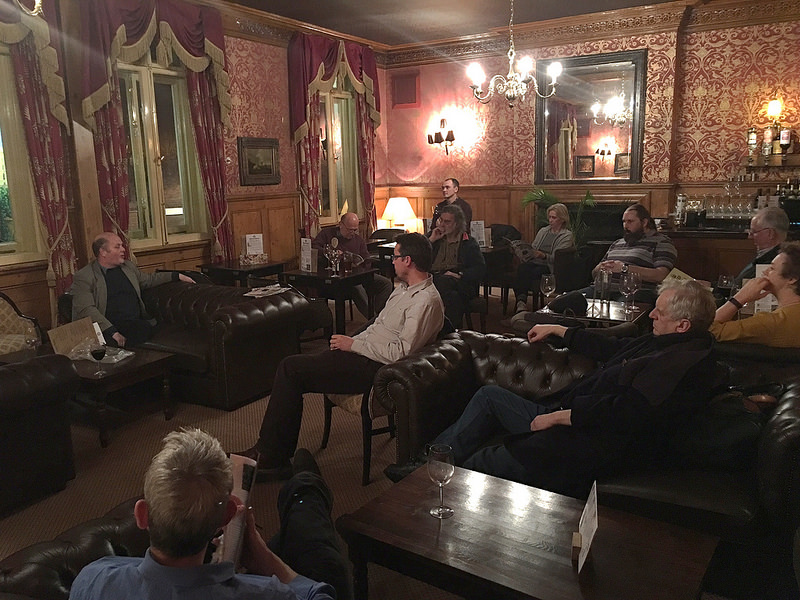
London vineyard movers meet for the first time
LAST NIGHT at the Windsor Castle, a lovingly restored Victorian pub behind Westminster Cathedral, it was business as usual for the packed clientele. But in the upstairs room something unusual was happening: the first meeting of London vineyards quite possibly since the Middle Ages.
London? Vineyards? The two words don’t easily sit together let alone drink together but the recent revival of winemaking in England has stirred some dormant roots. London used to be awash with vineyards – several not far from the pub – until climate change, the dissolution of the monasteries and other factors saw them off. Today with the price of land you would have to be a crazy billionaire to plant a vineyard in central London.
But there are other ways to achieve the same aim as the 15 or so pioneers gathered there last night illustrated. They included Sarah Vaughan Roberts, founder of a very promising 10-acre community-run vineyard in Enfield, Richard Sharp of Urban Wine, producer of Chateau Tooting a crowd sourced project gathering grapes from allotments and back gardens and turned into wine by an established winemaker, and Marko Bojcun and his business partner, Craig who make wine on their own account at Organiclea Hawkwood in Chingford and for a couple of dozen domestic growers in the Lea Valley. Paul Olding, author of The Urban Vineyard, a great beginner’s guide to grape growing, is expanding his Olding Manor allotment in Lewisham to, literally, pastures new in East Sussex. Tony Hibbett manages the hitherto abandoned Clocktower Vineyard, located in a public park in West London.

Sarah Vaughan Roberts of Forty Hall with other producers, right
.
.
.
.

Richard Sharp of Chateau Tooting with a copy of UKvine, below
Common problems included what to do about rampaging birds from pigeons that get under the netting to starlings which gobble up the whole crop and even flocks of ravenous parakeets. Observing closely was James Graham, publisher of UKvine, the first magazine devoted entirely to English and Welsh wine.
A theme soon emerged. Where do we go from here? Everyone seemed to agree that the next step might be a kind of virtual vineyard in which home growers, as well as depositing a wide variety of often unknown grapes of varying qualities with the likes of Chateau Tooting and Organiclea, could grow a couple of agreed varieties – say, Regent for red wines and Phoenix for white – while sharing experiences.In this way it might be possible to produce a high quality wine with, who knows, a London appellation.
How to publicise it? Obvious routes include contacting allotment societies and city farms – plus getting a sampling table during English Wine Week. Other suggestions welcome! I am trying to re-open the comments slot here which has been closed because of spam. We are most grateful to Dee & Mark Brecknock, managers of the Windsor Castle for letting us have a room in their splendid pub.
Leave a Comment » | Uncategorized | Tagged: Chateau Tooting, Forty Hall, London vineyards, Paul Olding, Windsor Castle | Permalink
Posted by shakespearesmonkey
Britain’s new vineyard destination – The Wye Valley
February 7, 2016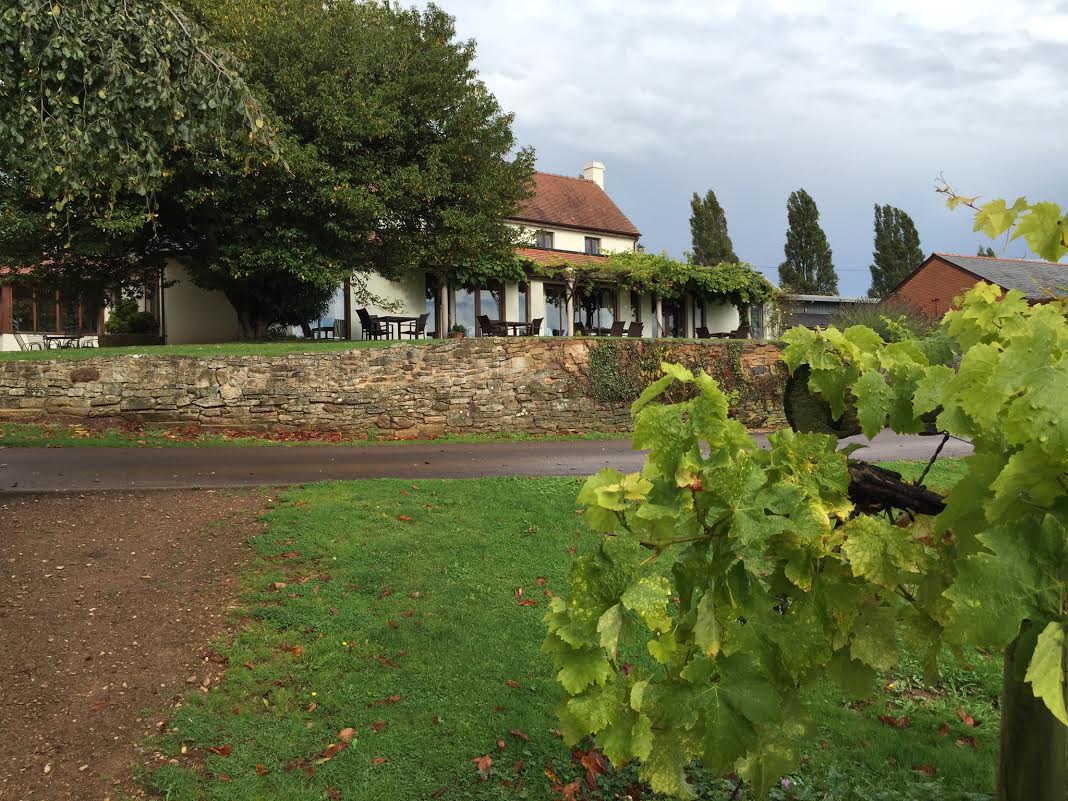
Three Choirs vineyard
THE WYE VALLEY has long been celebrated as an area of outstanding natural beauty, lauded by poets such as Wordsworth, Pope and Gray. It also has a strong claim to be where the modern tourism industry began when the gentry, deprived of the Grand Tour by Napoleon’s army, had to discover their own country instead. What it is definitely not famous for is vineyards. This is not because it hasn’t got any but because Wyedean as it is now called (Wye Valley and Forest of Dean) straddles two countries – England and Wales -and three counties – Herefordshire, Gloucestershire and Monmouthshire – and so gets lost among the geographical boundaries into which vineyards are divided by officialdom.
In fact the Wye Valley has a good claim to be one of the strongest growing wine areas in the UK and deserves to become a vineyard destination in its own right. Until a few years ago the only vineyard in the area to have won gold medals was Three Choirs which remains one of Britain’s most successful estates.
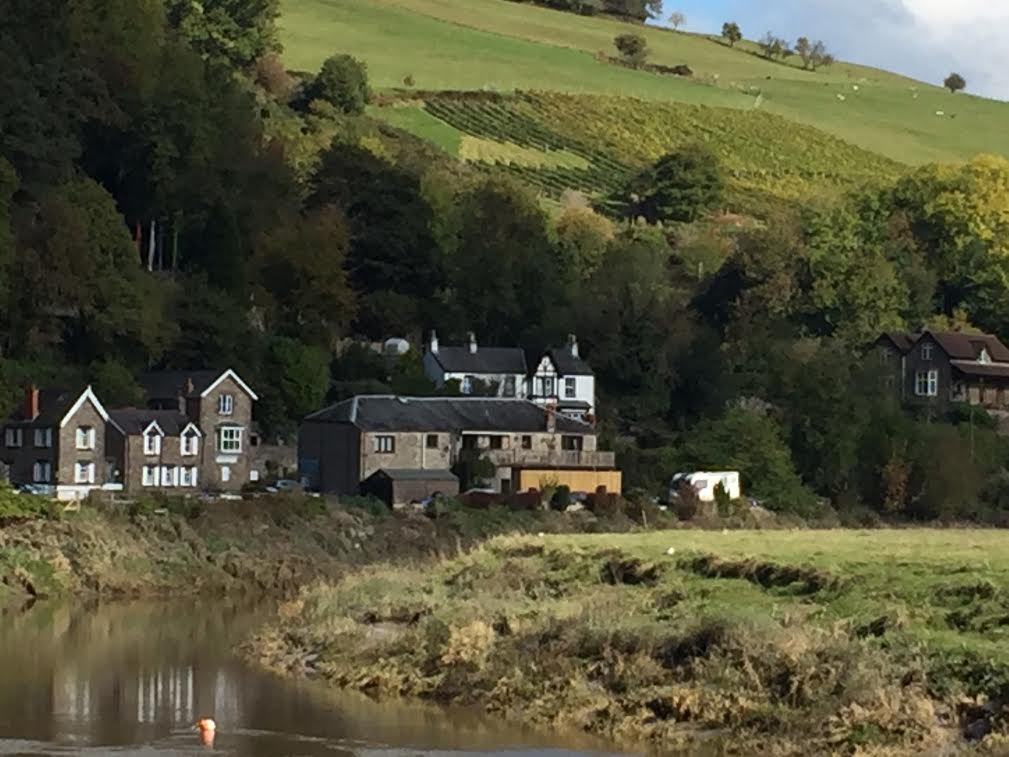
Parva Farm vineyard at Tintern
To experience the rising vinicultural clout of Wyedean take a road trip upstream starting at historic Tintern Abbey where on a hillside on your left you can see most of the 2.5 acre site of Parva Farm Vineyard which punches way above its weight having won a slew of silver medals and last year in the Welsh Vineyards Association (WVA) competition won a gold for its 2013 Bacchus. It actually attracted national headlines recently when Marks & Spencer gobbled up its stock of Bacchus. You have to negotiate a steep slope before arriving at the vineyard itself with a pleasant shop and chairs and tables outside with sheep meandering around the vineyard itself. I am told that its Mead is also very good.

Ancre Hill, Monmouth
Further upstream a mile outside the delightfully unspoiled country town of Monmouth, birthplace of Henry V, lies Ancre Hill Estate, the pride of Welsh vineyards. It burst on to the scene from nowhere in 2012 when its sparkling Seyval was voted the best sparkling wine in the world in a blind tasting by international experts at the Bollicine del Mondo in Italy against stiff competition from champagnes. Such was the disbelief that it wasn’t even reported in the local paper, the Monmouthshire Beacon. English and Welsh wines still have a big psychological barrier to break through.
To prove this was no fluke it has won several more golds since – including one in a Chinese competition and two in this year’s WVA contest with a Chardonnay and a 2009 barrel fermented sparkling. Ancre Hill – the French sounding name may have a Huguenot origin – is situated like so many Welsh vineyards – on a gentle slope with misty hills in the background. Here the Morris family have built an impressive state-of-the art biodynamic winery to process all their grapes including those from a large new field they have recently purchased on the other side of Monmouth very close to the Wye itself. Their ambitions have clearly not been satisfied yet. Sadly, the Monnow Valley vineyard in Monmouth, also near the Wye, is closing for family reasons having been a regular supplier to Waitrose for some years.
However a new vineyard has sprung up in its place a few miles away in Herefordshire off the Goodrich to Ross-on-Wye country route. You can’t see it from the road but once you have negotiated a few narrow lanes you encounter Wythall, a spectacular, and spectacularly unspoiled, 500 year-old Tudor mansion behind which Frank Myers has single-handedly planted nearly 3,500 vines on a 3.5 acre site. This year’s harvest, he says, is three times as big as last year’s with the reds looking particularly encouraging. The outbuildings are planned to house a cellar door eventually and shop which will make it a unique vineyard experience.

Wythall, the Tudor mansion
The house has been owned by the family of his wife – the Euro MP Anthea Mcintyre since the early 17th century and the original wine cellar of the house is now their HMRC-certified bonded cellar. The first wines under a “Tudor Manor” label (what else!) have been processed locally by Three Choirs and are due this year. If he can match the quality of the wine with the history of the house it wil be quite something.
Further along the Goodrich to Ross road along a right turn after Walford is the road past Coughton to Castle Brook, (photo at bottom of page) an exceptional vineyard run by the Chinn family, the largest asparagus growers in the country. They diversified a few years ago into making sparkling wine on a beautiful steep two hectare slope near what is thought to have been a Roman vineyard. In a light-hearted gesture to their family history their early wines were called Chinn-Chinn, a motif, which is still retained on the label.
They don’t need any gimmicks now. Their 2009 sparkling, made with classic champagne grapes and left on the lees for over four years has become one of the most decorated wines in the country including gold – and wine of the year- in the South- west Vineyards compeition and most recently a gold at what is arguably the most prestigious competiton of its kind in the world – the Champagne & Sparkling Wine World Championship – which attracts some of the best Champagne labels. Views and sales by appointment or from their website.
On a much smaller scale is Beeches Vineyard at Upton Bishop where John Boyd and his late wife Ikka established a fine vineyard behind their handsome country house not far from the Moody Cow gastronomic pub which they supply along with other outlets. In the 2015 South West Vineyards Association competition Beeches won a silver for its 2014 red which was also voted the best red in the whole region.
A few miles to the north Wyedean springs an unusual surprise – three vineyards within a mile of each other as the crow flies (with a fourth on the way). Can anyone top that? Alan Oastler, whose day job was as a nuclear scientist until his recent retirement has a 5.5 acre vineyard at Compton Green on a lovely slope where he grows grapes for his very drinkable English wines. He had to stop calling it Gloucestershire Regional Wine because of EU rules. He sells thrrough local outlets including Waitrose and also supplies fruit to Three Choirs. It is a pure vineyard without a cellar door.
A short distance away is what is confidently claimed to be a unique vineyard. Strawberry Hill (photo below) says it is the only one growing grapes on a commercial scale under glass (over an acre) as well as outside. And if that claim is ever challenged then it is surely the only one anywhere in the world growing under glass with two rows of mature banana trees guarding them. Strawberry Hill makes very tasty wines on its own account – including Merlot, Pinot Noir and Cabernet Sauvignon from the greenhouses – though most of its current production goes to wineries for their own labels. I had a delicious rosé there the other day. A few hundred yards from the entrance to Strawberry Hill another vineyard is being planted which we may hear more about later.
But the undoubted star of Wyedean wineries and almost next door to Strawberry Hill is Three Choirs, (photo at top) which has been one of the trendsetters of modern English vineyards for over 40 years. It not only makes its own fine wines – one of the few English wines the choosey Wine Society has been selling – at competitive prices – for years but it also acts as an ecosystem processing grapes from miles around in England and Wales (including Ancre Hill’s world beating Seyval). With 30 hectares (74 acres) it has long been one of the biggest vineyards in the UK and last year it purchased Wickham vineyard in Hampshire to expand its activities.
You can find other venues with even better wines and better restaurants – though its own are of a very high standard – but Three Choirs is hard to beat for the total vineyard experience – a lovely approach road through the vines, a compact shop, easy parking, accomodation of a high standard and a lovely restaurant with spectacular views across the rolling acres with a terrace that in summer feels like being transported to Provence. And it is among the top value-for-money vineyards as well.
There are other smaller vineyards such as the Pengethley Manor Hotel on the Ross-on-Wye to Hereford road which has an acre of grapes which are processed by Three Choirs and sold in its restaurant, Coddington, near Ledbury and Kent’s Green, near Newent, a family owned one managed by Charlie Peak who has a lovely spot with grapes growing over his walls as well as in the small vineyard. But they are not yet in the same league as the bigger ones which increasingly look like a vineyard trail waiting to be exploited. All they need, maybe, is a latterday Wordsworth to do them justice.

Strawberry Hill, complete with banana trees
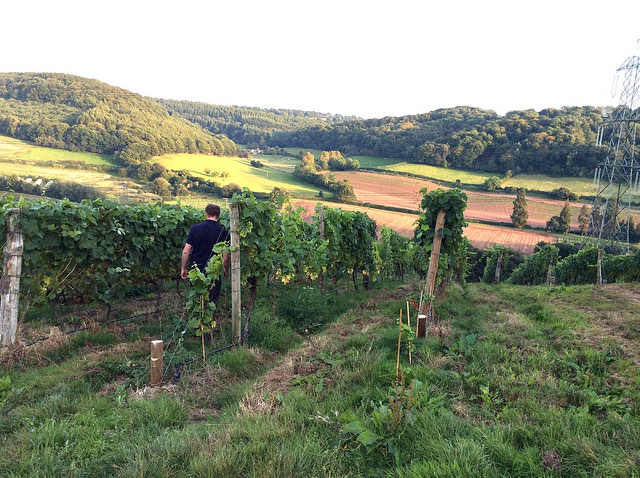
Castle Brook
Leave a Comment » | Uncategorized | Tagged: ancre hill, Castle Brook, Monmouth, Parva, three choirs, tintern, vineyard destination, Wye, wye valley | Permalink
Posted by shakespearesmonkey
Christmas lunch – two wines from London
December 24, 2015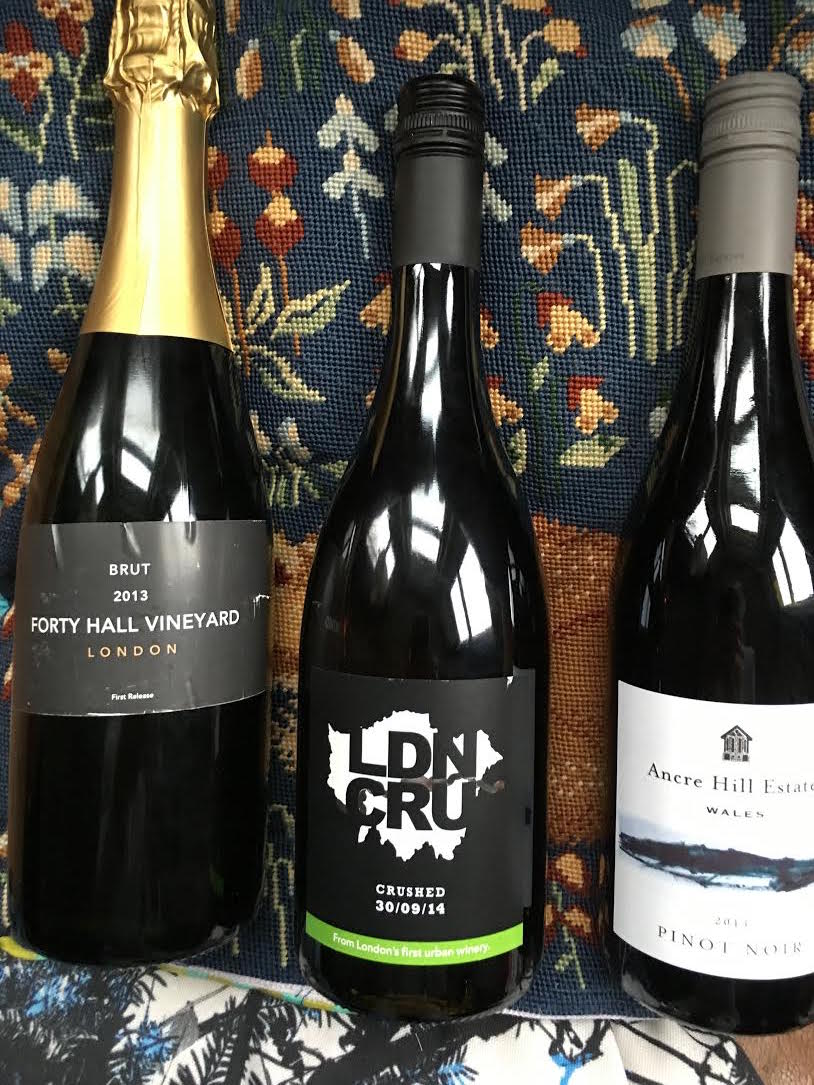
THIS YEAR we are going to have two wines from London (yes, London, England) and one from Wales for our Christmas lunch. If this doesn’t get us into the Guinness Book of Records nothing will. As an aperitif it will be Forty Hall sparkling, claimed to be London’s first sparkling wine for centuries. I managed to get a bottle because as a patron I was entitled to just one as output is being restricted in early years in order to boost future growth. I was going to keep it for a while as it is rather young for a sparkling but then I was offered the opportunity, again as a patron, to buy another two bottles – so that made it worth the risk of opening one for Christmas. Forty Hall is London’s largest vineyard for a very long time and maybe ever. It is an inspired community-run 10-acre project at Enfield whose grapes are turned into wine by Will Davenport, one of England’s most respected winemakers.Can’t wait.
For the turkey there is a choice. For some reason – and I am not sure where I went wrong – the rest of the family always prefers white to red. So there will be a bottle of LDN Cru, a Bacchus made at what is claimed to be London’s first urban winery in West Brompton using grapes from the family-owned Sandhurst vineyards in Kent. Purists may argue whether this is really a London wine as the grapes are grown outside the capital. But vineyards such as Chapel Down and Camel Valley always brand under their own labels even when the grapes come from Essex or wherever. For me it’s London and I look forward to a glass.
Finally, another first – a domestic red with the turkey. I am very interested in the way Pinot Noir – the grape behind Burgundy – is developing in the UK as a premium product and have already been very impressed with Gusbourne and Hush Heath Pinots this year. I also have bottles of Sharpham and Three Choirs gathering age. But this time I have decided on one from Ancre Hill in Monmouth. Their sparkling whites have been festooned with gold medals but they also have a long-term interest in producing top quality Pinot Noir in Wales. Well, that was the difficult bit. Choosing. Now it is all over bar the drinking. Happy Christmas to all.
Leave a Comment » | Uncategorized | Tagged: ancre hill, Christmas, drinke, Forty Hall, Gusbourne, LDN Cru, London, noir, Pinot, wine, wines | Permalink
Posted by shakespearesmonkey
How far north can a vineyard go?
December 2, 2015
Vines on a gentle slope in Norway
JOAR SAETTEM produced “a nice floral wine” from the Solaris grape in 2014. Nothing particularly remarkable about that. Except that it was grown at Lerkekasa in Norway on latitude 59.4 in what is claimed to be the most northerly vineyard in the world. It sits on land rich in minerals with plenty of sun and reflected light from nearby Lake Norsjø.
This is the most extreme example of vineyards moving North, a trend that is taking hold in England as well as in Sweden and Denmark – though they are all considerably further south than Lerkekasa. Viticultural pioneers are taking a bet that global warming is on the way even though it involves a constant battle against the elements. This northern march has plenty of lessons for the whole of Britain as new vineyards move steadily up country to take advantage of improved techniques, hardier varieties and the challenge of the unknown.
The Solaris grape – hardly a household name in the south – seems to be becoming the grape of choice to make white wines in these pioneering cool and cold-climate vineyards in England, Scotland and North Wales.
The Solaris grape growing in Norway
Norway may be setting the pace but on my reckoning (corrections welcome) three of the next four most northerly vineyards after Lerkekåsa are in Scotland and not in Scandinavia.
The most bizarre – to southerners – is Polycroft on the remote Isle of Lewis in the Outer Hebrides – on 58 degrees latitude (the higher the latitude, of course, the further north). It grows mainly Black Hamburg grapes in polytunnels for sale at local markets in Stornaway but also makes a wine which is distributed to family and friends. The proprietors Donald Hope,a former missionary, and his wife Jean have no comment to make on the quality of their main wine, rosé. They are teetotal.
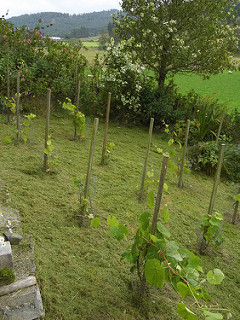
Alan Smith’s experimental vineyard at Glenkindle, Scotland
Further south, but still pretty far north, on latitude 57, Alan Smith has a southern facing slope 800 feet at Glenkindle – it means “dale of roses” – on the eastern side of the Cairngorms National Park where he has established a small private experimental vineyard (picture, right) to explore the hardiest grapes that can be grown in Britain. The fashionable Rondo (red) and Solaris (white) are not hardy enough for these parts so he uses Baltic and Russian hybrids such as Dalnivostock Ramming and Jublienka Novgoroda. He doesn’t think global warming is that important because, he says, a lot of the plant types that grow in the south of England also grow at 57 degrees north though the varieties are different.
He has about 200 vines spread among greenhouses (for table grapes), pots, a polytunnel (for wine) and two areas for outdoor vines. He hopes to produce his first bottles of wine next year. His progress is likely to be watched carefully by grape aficionados for one very good reason. Glenkindle is on the same latitude as the Great Glen and Loch Ness which Professor Richard C Selley in his influential book The Winelands of Britain has predicted will be an ideal geological structure to plant vines in the future if global warming continues. Maybe, one day, there will be the equivalent of a gold rush for land in the Great Glen – but not yet.
All of this leaves unchallenged the claim of UKvine’s esteemed food columnist Christopher Trotter to have made Scotland’s first wine on a proper basis at his Momentum vineyard at Upper Largo in Fife on latitude 56. This year he produced the first bottles of Chateau Largo with the Solaris grape which accounts for 75% of the 200 vines he has planted so far. He is honest and wise enough to say that he is unhappy with his first vintage and won’t share it yet – not even with a fellow columnist. But he believes he has learned from his mistakes and hopes eventually to raise money to plant over two hectares.
Scotland is no stranger to viticultural success. In Victorian times William Thomson established Clovenfords Vineries in 1870 and planted five acres of vines under glass, with miles of hot pipes to maintain the right temperature. It created a thriving business in table grapes for 90 years under four generations of the family until a collapse in the world price of grapes put paid to the experiment. High point? While working for the Duke of Buccleuch, William entered grapes into a competition in Paris for the Grand Gold Medal of the Central Society of Horticulture of France. And guess what? He won and, to the consternation of the French who couldn’t believe that grapes grown in wild Scotland could challenge their Divine Right to viticulture, was handed the gold medal by the Emperor of France.
In England, Astley, a lovely secluded vineyard in Worcestershire, was for a long time deemed the most northerly UK vineyard before Renishaw Hall near Sheffied took over the mantle – but now there are over two dozen further north than Astley and they are winning prizes in international competitions. Ryedale at Westow near York in Yorkshire, on 53.9 latitude has ten acres and claims to be the most northerly commercial vineyard in Britain. No one in Scotland will argue with that – for the moment.
Rydedale makes most of its wine in its own winery and has won a string of bronze medals in international competitions plus a silver medal in United Kingdom Vineyards Association 2013 competition for its Shepherd’s Delight rosé. But pride of place for quality among Northern vineyards must go to Bill Hobson of Somerby Vineyard in Lincolnshire who won a gold medal at the 2014 English & Welsh Wine of the Year show for his – you’ve guessed it – Solaris still white.
Solaris slso featured in another stunning success for a Northern(ish) vineyard when Kerry Vale on the English/Welsh border at Pentreheyling in Shropshire, won one of only seven silver medals awarded to English vineyards for its Shropshire Lady dry white at the very prestigious International Wine Challenge 2015. It is a delicious wine and has become one of our favourites.
One could go on but the point is made. The success of British wines is moving slowly northwards thanks to improved techniques, climate changes and the unflappable enthusiasm of the British to produce wine from their own soil. Loch Ness, here we come.
Edited version of article in the current issue of UKvine (printed editions only)
Leave a Comment » | Engilsh vineyards, sparkling wine | Tagged: christopher trotter, Hebrides, northern, Norway, polytunnels, Scotland, Solaris, Vineyards | Permalink
Posted by shakespearesmonkey
Future rosy for English red wines
November 8, 2015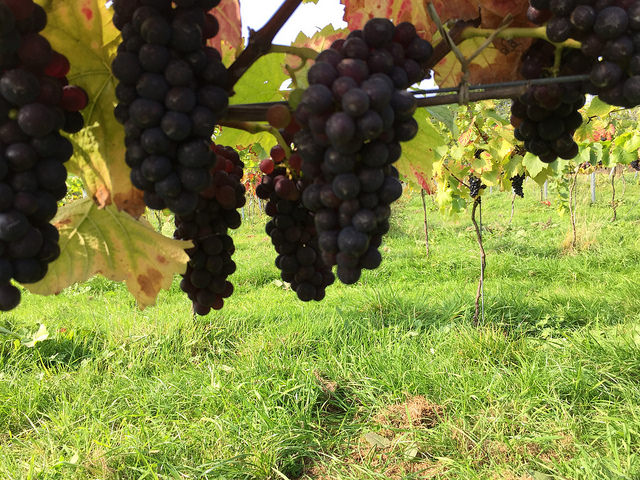 Pinot Noir ready for the picking at Forty Hall vineyard at Enfield, London
(Edited version of an article in the current UKvine)
ENGLISH AND WELSH sparkling wines are now acknowledged to be world class. Still whites are starting to make an impact but our reds seem destined to linger in a viticultural Limbo, the gates to Paradise steadfastly denied. In 1691 Richard Ames wrote an epic poem about his fruitless search for a decent glass of claret in the inns of London, castigating nearly all the innkeepers for the rubbish he tasted. If Ames were alive today he might have done a similar walk looking for a decent glass of English red except, of course, that hardly any pubs serve it. Maybe he would be harranging them for not.
Yet the fact is a lot of English reds taste better than the mediocrity so often served in pubs but they are either not marketed properly or, more likely, too expensive for publicans who often won’t buy for more than £5 a bottle wholesale – before they treble or quadruple the price when they sell it. Richard Ames would have had something to say about that
There is hope. The grape that gave Bergundy its charisma, Pinot Noir, notoriously moody to grow over here, is beginning to make its mark in the UK. Jilly Goolden in a recent blind tasting said of Gusbourne Estate’s 2011 Pinot Noir that it was “divine” and could not possibly be English because we struggle to make red. Wine expert Stephen Skelton said the same wine was the best English red he had tasted. Maybe we are all a bit blind to our own achievements. I purchased Sharpham’s much praised Pinot Noir and Précoce 2011 recently and they told me to lay it down for a few years. I did what I was told, totally fazed by this being the first time anyone had recommended laying down an English wine for so long. Bolney also makes a good Pinot (its Foxhole 2013 won a silver medal in this year’s International Wine Challenge) and Ancre Hill in Wales has high hopes as does brand new vineyard Jabajak deep into west Wales despite being located rather high up.
But Pinot Noir is not the only fruit. Some vineyards are having success with Regent which is relatively easy to grow and fairly disease resistant. Professor Richard C Selley in his seminal book, The Winelands of Britain said that good red wine has been difficult to produce but things were changing with the introduction of Rondo, an immigrant from Manchuria which, he observed, produces “excellent red wine in marginal climatic conditions”.
Leave a Comment » | Uncategorized | Tagged: Bolney, Denbies, english, Gusborne, Pinot Noir, red, red wine, rondo, welsh | Permalink
Posted by shakespearesmonkey
Can Britain make sparkling wine as well as posh fizz?
October 12, 2015
Rathfinny (above) has gone into high quality fizz in a big way -but no-one competes at the cheaper end.
BRITAIN’S motor industry is brilliant at manufacturing custom-built premium cars but no good with volume cars (at least until overseas buyers showed us how). Is it the same with sparkling wine? English and Welsh sparkling wines have done amazingly well, regularly winning gold medals against the rest of the world including Champagne. At the recent International Wine Challenge (IWC) England won a record 14 gold medals compared with 30 by France which has hugely more vineyards.
But at the cheaper end of the market it is a different story. Prosecco, that lovely sounding – if ancestorally challenged – Italian sparkling wine has swept all before it at the £5 to £10 a bottle end of the market. It has seen off Cava, the Spanish equivalent – though made slightly differently – which once dominated the lower end of the UK market. It hasn’t seen off cheap English sparkling for one very good reason. There isn’t any.
I can’t think of a single English vineyard producing sparkling wine at under £10 a bottle. As a result, although UK sparkling is a great success story it can’t hold a candle to Prosecco in terms of quantity. According to Mintel, sales of Prosecco rose an astonishing 75% in Britain in 2014 to approaching £1 billion and overtook Champagne for the first time. Since Champagne sales also rose strongly Britain’s balance of payments on sparkling account is getting much worse despite the success of British fizz.
Why can’t we produce affordable sparkling? After all, our farmers produce lots of high volume food from peas to asparagus. Why not a British Prosecco? During the IWC tasting day I asked a number of our leading vineyards whether they had thought about moving into the sub £10 market. Only one said it was contemplating such a move. The others quoted the same reasons for steering clear: heavy investment, lack of economies of scale, lower yields per acre in the UK, changing fashions etc. Stephen Skelton, the wine expert, says in his new book Wine Growing in Great Britain that the sub £10 a bottle matrket is not a price sector that uk producers “want to, or can afford to be in”.
He may well be right but this sort of reasoning does not stop us from investing in other farm products. If Britain’s farmers were faced with £1 billion imports of a cheaper form of carrot they would respond immediately. Is it just because noone has tried?
Prosecco is much cheaper to produce than Champagne-style wines which have to be matured in bottles over a number of years. It is fermented in tanks rather than bottles and can be ready to sell in a matter of months so it’s good for cash flow.
Of course, there is the major question of branding. What could we call it? Prosecco has a posh(ish) image even though it could soon lose it by becoming too cheap (I bought a bottle in Aldi recently for £5.29p of which £2.63 was duty and when you add in Vat, transport and production costs it doesn’t leave much, if anything, for profit). Other Proseccos sell for up to £10 or more so there is still a lot to play for.
Prosecco used to be the name of the grape as well as the region – so British vineyards could have marketed similar wines under that name. But Italy wised up. It is still the same grape – Glera – but since 2009 Prosecco can only legally come from the region. That’s what I mean by ancestorially challenged.
Britain’s challenge is to find someone bold enough to produce it on a big scale and then sell it under a catchy name to satisfy the exploding consumer demand for cheap Prosecco-style sparkling wines. In other words to do what Rathfinny – which is planting over 400 acres – is doing at the premium end of the market: Think big and reap economies of scale. Is there anyone out there ready to to take the risk?
(Edited version of an article in UKvine, the new magazine dedicated to English and Welsh wines)
Leave a Comment » | Uncategorized | Tagged: Cava, english wine, fizz, motor industry, Prosecco, Rathfinny | Permalink
Posted by shakespearesmonkey
England’s mystery grape – myth or magic?
September 9, 2015
Wrotham Pinot maturing

Wrotham Pinot matured
IF SHERLOCK HOLMES had been interested in English wines, he would surely have tried to solve the mystery of Wrotham Pinot, an intriguing English mutation of the classic Burgundy grape Pinot Noir. It was supposedly grown in England by the Romans and later by medieval monks but has disappeared without trace from its native land though cuttings – it is claimed – taken from the UK have been grown very successfully on a two-acre site at a Yountville vineyard in California’s Napa Valley.

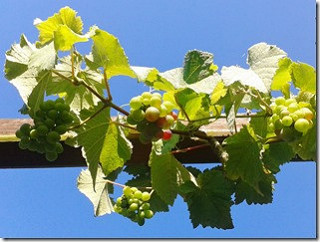
If true this would be of great interest to the burgeoning UK vineyards growing Pinot Noir because this variety is claimed to ripen two weeks earlier with higher sugar content and is apparently immune from powdery mildew which afflicts the standard varieties.
Edward Hyams, one of the pioneering British viticulturists says he discovered it on a wall in Wrotham (pronounced ‘Root-um’) in Kent in the late 1940s. It was almost certainly a variety known as ‘Miller’s Burgundy’ because the flour-like texture of its leaves reminded locals of mill workers after a long day’s milling. It had been grown on walls for many years having been originally discovered by the great horticulturalist Sir Joseph Banks in an ancient vineyard at Tortworth, Gloucestershire. However, I have been reminded by Stephen Skelton that Pinot Meunier leaves all have that flour-like appearance.
Hyams apparently took the vine to Ray Barrington Brock at what was to become the Oxted Viticultural Research Station, and he trialled it alongside the many other varieties he grew.
It was during a visit to Britain around 1980 that the distinguished US viticulturist Dr Richard Grant Peterson came across a wine made from Wrotham Pinot and although it wasn’t very good there was something in it that attracted him enough to take cuttings back to California, where, after meeting lengthy quarantine rules, he planted what eventually became two acres of Wrotham Pinot which still exists today and the wine from which has won prestigious gold medals. It has been described as the “most unique vineyard in the whole of the Napa Valley”. But it has yet to be established that he took the cutting from Wrotham and he has been mute on the subject when approached.
So what happened to this wonder vine in Britain? Does it join the embarrassing list of things discovered in the UK but exploited abroad? Is it still growing somewhere? Or should it be in the Loch Ness family of rural myths? It was after reading Stephen Skelton’s excellent Wine Growing in Great Britain – and an earlier book of his – which first alerted me to Wrotham Pinot that I decided to do a little sleuthing myself (though Stephen himself is now highly sceptical that Wrotham Pinot – which is an officially designated vine in the UK – is anything other than a Pinot Meunier).
In his book A Vineyard in England, Norman Sneesby chronicles his progress in establishing a vineyard on the Isle of Ely in 1973 where among other varieties he planted 100 cuttings of Wrotham Pinot. These produced 48 rooted plants which were looking healthy until they were “taken by the birds”.
A few years later Dudley Quirk grew Wrotham Pinot on his – now defunct – 65 acre vineyard at Chiddingstone near Wrotham in Kent. Some locals believe it was served at a banquet given by Margaret Thatcher for President Mitterrand but it was probably another variety from the same vineyard.
It occurred to me that it was possible that there might still be enthusiasts in Wrotham who had taken cuttings from the original vine – long since gone – on the garden wall which was supposedly somewhere along the main street. I wrote to the Parish Council and others looking for a lead. My email was forwarded to Brian Saunders of the Wrotham Allotment Society. He was very knowledgeable about the grape and not only had one growing in his garden (see pictures above, courtesy of Brian) but knew of around eight other locals who had taken cuttings from him and were now growing it themselves including one who has 12 vines growing on his allotment. Brian says he had got his from Dudley Quirk at Chiddingstone: “He gave me half a dozen cuttings around 1987… I potted them up and after a year planted one out”.
He added that the historical society established contact with the vineyard in Napa Valley and two of his neighbours visited it bringing back some bottles back for a wedding. One of them made wine from Wrotham grapes which was “passable but a bit acidy”. Brian has two bottles of the Napa Valley Wrotham Pinot which he hasn’t opened – one sparkling pink and the other an off dry white.
Whether all this is nothing more than an interesting sidebar to a curious story remains too be seen. The question is whether Wrotham Pinot – with its claimed near immunity to powdery mildew and the benefit of early fruiting – is worth re-planting in Britain given the increased interest in Pinot Noir among UK vineyards and all the improvements in technical ability and climate that have happened since it was last planted. You don’t have to swallow whole the seductive claim that it was the original variety introduced by the Romans – for which there is as yet no archaeological evidence – to accept that Wrotham Pinot, if it exists at all as a distinctive mutation, would be something special.
@BritishWino
Leave a Comment » | Uncategorized | Tagged: Chiddingstone, Dudley Quirk, english, Kent, Napa Valley Richard Grant, Peterson, Pinot Noir, Stephen Skelton, Vineyards, Wrotham | Permalink
Posted by shakespearesmonkey


 Victor Keegan