Did the English wine revolution start in, er . . . Essex?
November 29, 2017One man and his vineyard
October 26, 2017PAUL OLDING has a bit of an advantage over the rest of us when it comes to planting a vineyard. He has already written a much praised book on the subject, “The Urban Vineyard” based on a tiny one of his own on an allotment in Lewisham, south London. Now, in fulfilment of a long held dream, he is going rural with Wildwood, a lovely one-acre vineyard on a sunny south/south-eastern facing hillside off a bridle path in vine-friendly East Sussex.
Having endured tortuous procedures to get planning permission both for the vines and a shed he then suffered the freak late frost after bud burst that hit vineyards throughout the UK inflicting wholesale damage on the crop. But those and numerous other problems are in the past. Now he and his family can now look with satisfaction at a thoroughly professional vineyard with no noticeable side effects from the frost.
It was a very un-Brexity multinational effort: vines and wires from Germany, end posts from Belgium, the larger cabin from Latvia, the smaller one from Slovenia, a tractor insured in Wales and a toilet from Ireland installed by Romanians. Skilled Romanians also put in all the posts (and planted the vines) as is common in English and Welsh vineyards. But the wine will be unashamedly English.
When? Paul, who is 44, believes in letting the roots settle and is planning only a small harvest in 2018 using two bunches from the stronger vines with a full harvest planned for 2019. The plot was purchased in 2014 but it took 18 months of preparation doing such tasks as reducing the acidity of the soil by spreading lime.
He is growing (highly popular) Bacchus, Regent and two varietals of Pinot Noir. This is clearly a fun thing for him and he is not expecting to make much of a profit and especially not if the huge cost of land is factored in. There are no plans to give up the day job as a TV producer/director (including some of Brian Cox’s films). With an acre of vines and several more acres of ancient woodland attached slithering down to a happy stream he has already created his own dream world. But he will still have to pray for good weather.
I am hoping to keep an occasional eye on Paul’s progress. You can buy his book at http://theurbanvineyard.co.uk/.
His website is wildwoodvineyard.co.uk
At last – a plaque for the man who proved that the English made “Champagne” first
May 26, 2017
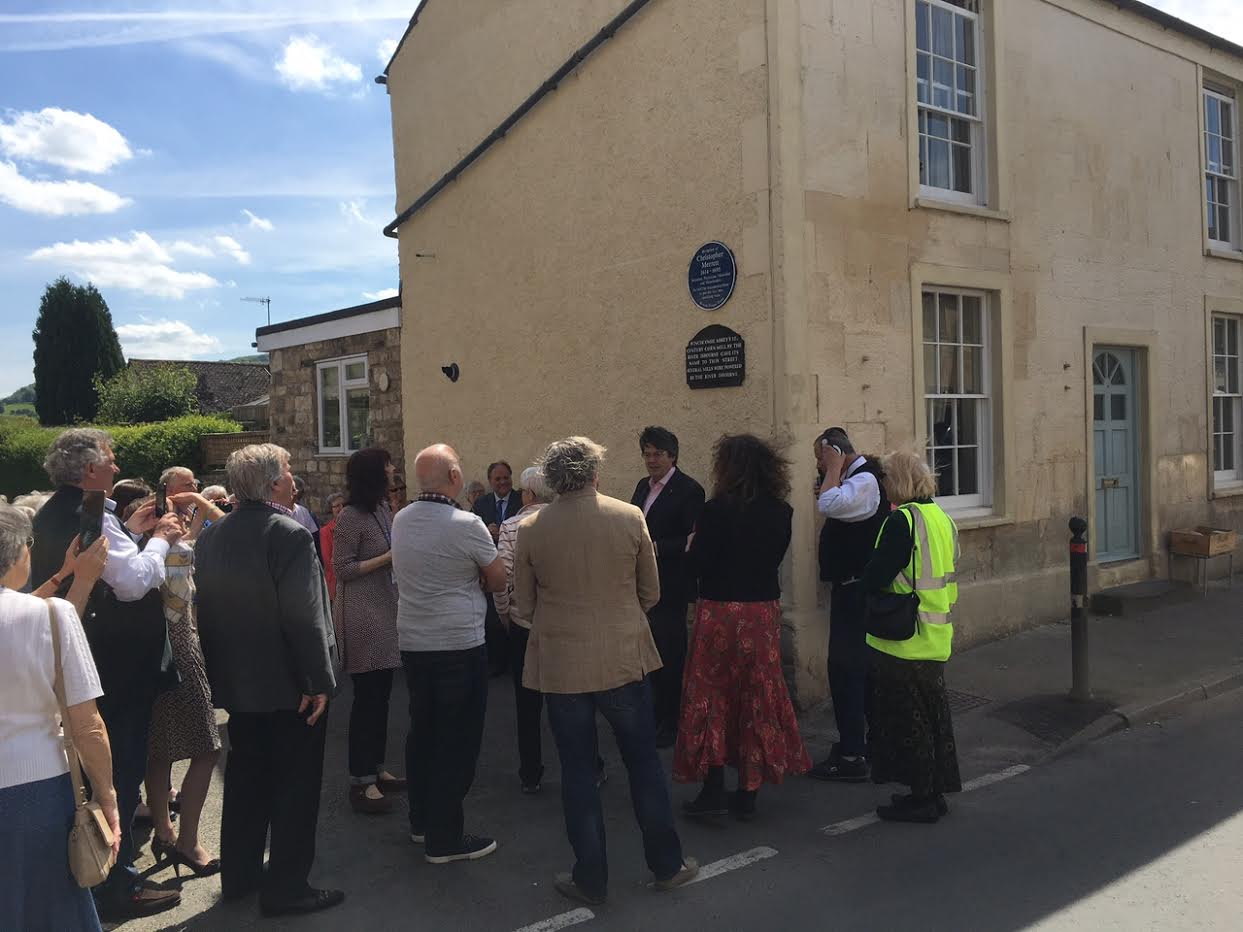
IT COULDN’T have been better timed. This week a long-awaited plaque was unveiled in Winchcombe, Gloucestershire at the birthplace of Christopher Merrett. It was Merrett who in a paper to the Royal Society in 1662 recorded that what came to be known as the méthode champenoise – ie secondary fermentation in the bottle – was actually invented by wine coopers in England decades before it was attempted by Dom Perignon. Most French people still, erroneously, believe that it was all due to the Dom, not the Pom.
It was a memorable occasion – with lovely wines supplied by Paulton Hill, which introduced us to its first sparkling, and Lovell’s vineyard which markets the fine Elgar range and is the nearest vineyard to the birthplace of Christopher Merrett. It was well timed because the English and Welsh wine revival seems to have entered a new period of growth. It is not just that a million new vines are expected to be planted this year – most of them for sparkling – but our still wines are starting to win serious prizes.
A fascinating example is the northernmost vineyard in North Wales, Conwy, (@conwyvineyard) which I visited two years ago and was told that New Zealand legend Kevin Judd, the man behind Cloudy Bay, on a visit to promote his new venture had noticed some grapes growing on a hillside as the train came into Llandudno station. He commented that it was a great position for a vineyard and he would love to come back for a tasting. Well, if he does he will find that Conwy, owned by a delightful couple Colin and Charlotte Bennett has just won one of only two silver medals awarded for UK still wines at this month’s International Wine Challenge. The other silver was awarded to LondonCru, which operates London’s first winery for centuries. Oh, and Conwy also won a bronze for its Solaris. Not bad for a vineyard of barely an acre in an area of Wales where most people would be amazed to find grapes growing at all.
The plaque at Winchcombe was unveiled by Mike Read, best known as a DJ but who has written 36 books, many on historical subjects, and is a founder of the British Plaque Trust. Mike boldly entered the controversy about what to call the indigenous sparkling wine discovered by Merret. He suggested English Royal which has a lovely prestigious ring about it – with hidden notes about Charles II who espoused the Royal Society – but I am not sure how it would go down in North Wales! But it is a lot better than the headline a bright sub editor wrote on an editorial I wrote about Christopher Merret’s discovery 20 years ago in the Guardian. It was “Champagne Pom” I was much moved by the warm reception a packed church gave to me for my talk on Merrett – including this poem . .
In praise of Christopher Merrett
(from my fifth poetry book LondonMyLondon published on Kindle this morning!)
What makes Champagne go full throttle,
Is secondary fermentation in a bottle.
This is an invention without which,
Sparkling wine would be mere kitsch.
And who made this spectacular advance?
Why, in folk law, a monk, Dom Perignon of France.
But wait: hear Christopher Merret’s scientific view,
Which he wrote in sixteen hundred and sixty two
Without any mock Gallic piety,
He told the newly formed Royal Society,
He’d discovered this oenological advance
That let wine ferment in bottles first,
That were strong enough not to burst.
T’was Britain’s gift to an ungrateful France
Decades before they gave sparkling a glance
It created that country’s strongest brand.
So, let’s raise a glass in our hand,
To a great man’s invention from afar
And drink to the Methode not Champenoise
But What should have been called Merrettoise.
So, let all by their merrets be
Judged – that the whole world can see
That however we may be thought insane,
We gave the French for free – Champagne.
Brexit good for vineyards? Don’t bank on it
October 4, 2016There is a wave of euphoria going the rounds of some vineyards about how Britain’s wine industry will benefit from Brexit. I hope this is right but it won’t happen if we only look at the benefits and not at the other side of the balance sheet. Sure it will make our exports cheaper as long as it lasts. But remember, the reason the pound has gone down is that the financial markets think Brexit will be bad for economic growth partly because foreign-own industries such as motor manufacturing and financial services – which came here to be inside the tariff barriers – will switch new investment and people to Europe. This will lead to higher unemployment in the UK and a big blow to confidence and spending power which may lead to fewer purchases of the more expensive domestic wines.
Devaluation makes exports cheaper but also imports more expensive. Virtually all of the machinery to pick and process grapes – like the massive press that arrived at Rathfinny this week – comes from abroad as do the vines themselves and many of the gangs that pick them.
It is all very well to presume that Brexit will lead to the Government reducing tax on English and Welsh wines but this is unlikely at a time when there will almost certainly be a rising deficit that the Government is pledged to eliminate albeit over a longer perion than previously thought.
In these circumstances the Chancellor would have to be barmy to reduce the duty on wine when 98% of the proceeds would go to importers who dominate the market. And if he decided to reduce the duty on UK made wines alone in a discriminatory way then that would be sure to trigger a retaliatory trade war abroad.
There could be unexpected benefits. If agricultural subsidies are eventually reduced sharply then that might persuade more farmers to invest in a growing indigenous industry rather than farming subsidies.
I remain bullish about the revival of the UK wine industry and it will be improved by a lower pound. But the irony is that if Brexit succeeds (very unlikely in my view) then the pound will once again strengthen thereby removing a competitive advantage that arose from expectations that it would fail.
Will still white wines be the next big thing for Britain?
July 27, 2016THE AMAZING resurgence of UK vineyards in recent years has overwhelmingly been the story of sparkling wines which have been so festooned with gold medals that even French champagne makers have woken up to it. But is the same success about to happen to our still white wines which have languished in the shadows for so long? You could definitely draw this conclusion from the recent English and Welsh Wine of the Year competition where an astonishing 20 out of 32 gold medals awarded went to white wines of which no less than 11 were made from the appropriately named Bacchus grape (after the god of wine) which is emerging as the UK’s still wine of choice for consumers. Several other non-Bacchus wines also struck gold including chardonnays from Chapel Down’s Kits Coty vineyard and from the long-established New Hall in Essex.
This competition was blind tasted by Masters of Wine judged, it is claimed, to international standards which means that there ought to be no national bias. The trouble is that at the more recent Decanter blind tasting – which includes wines from everywhere and not just England and Wales – there were no golds for Bacchus or indeed any other still wines from the UK though there were three silvers (plus a few more for other still whites). This is par for the course for international competitions. So what on earth is going on? There are various explanations. It could be that domestic Bacchus producers did not enter in sufficient numbers for Decanter. Maybe there a subconscious patriotic preference for home producers by the judges. Not at all unlikely. Or , just possibly, the success of Bacchus in domestic competitions is a lead indicator of what is to come in international blind tastings. After all, our sparkling wines were hailed at home long before they started winning prizes in international competitions. Or, perish the thought, wine tasting is a much more random operation that its participants like to admit.
Either way, there are lessons here. Maybe the new vineyards being planted here which are overwhelmingly of the three varieties that make up classic Champagne wines – Chardonnay, Pinot Noir and Pinot Meunier – should look to plant more for still wines. Of course, if the market changes, it is easy to produce still white from Chardonnay vines and still red from Pinot Noir, which is gradually improving in quality in this country. But Bacchus, which is a cross between hardy Germanic varieties Mullar-Thurgau and Sylvaner x Riesling, is clearly emerging as the cheer leader for UK wines with a name to conjure with.
Bacchus wines are not cheap being mainly priced around the £14 mark though at the time of writing you could get a Brightwell Bacchus at £9.99 from Waitrose and a 2014 from Chapel Down for £11.50 from the Wine Society. Waitrose is the best place to look for English and Welsh wines if you are not buying from a vineyard, not least because they occasionally have special offers with cuts of 25% or more and they have over a 100 English and Welsh wines on offer. The choosey Wine Society (lifetime membership £40) has a much more limited but high quality list including a couple (non Bacchus) at under £8. Both organisations have free delivery if you buy by the case.
So it looks as though Bacchus will be a premium priced wine like our sparkling wines. If you haven’t got the economies of scale of overseas producers it makes sense to sell on quality. The name Bacchus can be used by anyone but the way things are going it could establish itself as a distinctively branded English still wine. That would be something worth waiting for.
Giving due Merrett to the English inventor of Champagne
May 7, 2016AT LONG last Christopher Merrett, the 17th century English scientist who first established what is now called the méthode champenoise – long before Dom Perignon – is to get official recognition. Local historians have now discovered exactly where he lived in the Gloucestershire village of Winchcombe and have applied for a plaque to be put up. When I wrote about this two years ago it was thought that the house – actually a pub – where Merrett was born was on Gloucester Street on the the corner of Mill Lane. This was true. But it turns out it was the wrong corner. The actual building is the one in the picture above and not the one on the other side of the lane part of which can be seen on the left of the photo. The house has been reconstructed since the 17th century but still has the original cellar and barrel roll.
Local writer Jean Bray and folk artist Katie Morgan have applied to have a plaque to commemorate Christopher Merret’s undersung achievement. Most people (especially in France!) still believe that Dom Perignon invented champagne but he actually came onto the scene nearly 30 years after Merrett.
In Merrett’s time Champagne in France was a still white wine. If a secondary fermentation happened it was regarded as a disaster because it would explode the bottles which were then made of weak glass. In a paper to the newly-formed Royal Society in December 1662 (uncovered by the champagne expert Tom Stevenson 20 years ago) Merret described how winemakers deliberately added sugar to create a secondary fermentation. There was no explosion because English bottles, unlike the French ones, were made in coal-fired furnaces able to produce stronger glass than the traditional woodburning techniques.
Merrett went to Oxford and worked in London while living in Hatton Garden which had a large vineyard in those days though it is not known whether Merrett was involved with it. He was buried in St Andrew’s Church, Holborn.

Jean Bray is to give a talk entitled “The Englishman who invented Champagne” at 7.30pm on Thursday May 26 at the Chandos Hall in Winchcombe as part of Winchcombe Festival of Music and Arts. It is sponsored by Strawberry Hill Vineyard of Newent which is one of the nearest vineyards to Winchcombe (price £8 including a glass of sparkling).
It is great that Winchcombe is celebrating its most famous son but there are dozens of vineyards around the country whose success can ultimately be traced back to Christopher Merrett (picture, left) who don’t celebrate him enough. This is partly because Ridgeview vineyard established Merrett as a trade mark. This may have been a shrewd move commercially but it may also have hampered the scope of vineyards in the UK to capitalise on a name that, in truth, ought to be more widely known than Dom Perignon.
Future rosy for English red wines
November 8, 2015
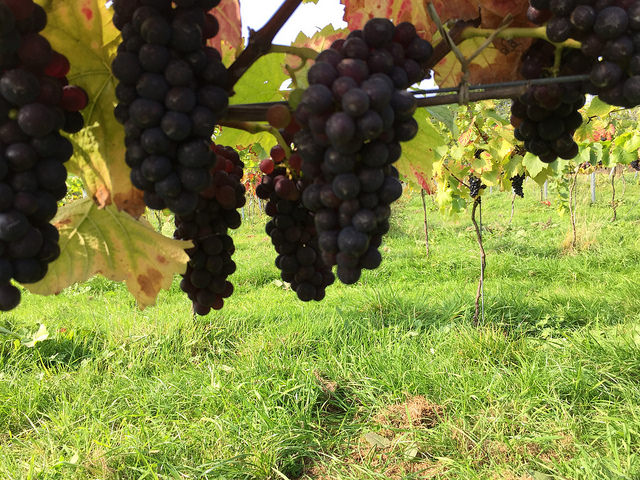
Pinot Noir ready for the picking at Forty Hall vineyard at Enfield, London
(Edited version of an article in the current UKvine)
ENGLISH AND WELSH sparkling wines are now acknowledged to be world class. Still whites are starting to make an impact but our reds seem destined to linger in a viticultural Limbo, the gates to Paradise steadfastly denied. In 1691 Richard Ames wrote an epic poem about his fruitless search for a decent glass of claret in the inns of London, castigating nearly all the innkeepers for the rubbish he tasted. If Ames were alive today he might have done a similar walk looking for a decent glass of English red except, of course, that hardly any pubs serve it. Maybe he would be harranging them for not.
Yet the fact is a lot of English reds taste better than the mediocrity so often served in pubs but they are either not marketed properly or, more likely, too expensive for publicans who often won’t buy for more than £5 a bottle wholesale – before they treble or quadruple the price when they sell it. Richard Ames would have had something to say about that
There is hope. The grape that gave Bergundy its charisma, Pinot Noir, notoriously moody to grow over here, is beginning to make its mark in the UK. Jilly Goolden in a recent blind tasting said of Gusbourne Estate’s 2011 Pinot Noir that it was “divine” and could not possibly be English because we struggle to make red. Wine expert Stephen Skelton said the same wine was the best English red he had tasted. Maybe we are all a bit blind to our own achievements. I purchased Sharpham’s much praised Pinot Noir and Précoce 2011 recently and they told me to lay it down for a few years. I did what I was told, totally fazed by this being the first time anyone had recommended laying down an English wine for so long. Bolney also makes a good Pinot (its Foxhole 2013 won a silver medal in this year’s International Wine Challenge) and Ancre Hill in Wales has high hopes as does brand new vineyard Jabajak deep into west Wales despite being located rather high up.
But Pinot Noir is not the only fruit. Some vineyards are having success with Regent which is relatively easy to grow and fairly disease resistant. Professor Richard C Selley in his seminal book, The Winelands of Britain said that good red wine has been difficult to produce but things were changing with the introduction of Rondo, an immigrant from Manchuria which, he observed, produces “excellent red wine in marginal climatic conditions”.
England’s mystery grape – myth or magic?
September 9, 2015
Wrotham Pinot matured
IF SHERLOCK HOLMES had been interested in English wines, he would surely have tried to solve the mystery of Wrotham Pinot, an intriguing English mutation of the classic Burgundy grape Pinot Noir. It was supposedly grown in England by the Romans and later by medieval monks but has disappeared without trace from its native land though cuttings – it is claimed – taken from the UK have been grown very successfully on a two-acre site at a Yountville vineyard in California’s Napa Valley.
If true this would be of great interest to the burgeoning UK vineyards growing Pinot Noir because this variety is claimed to ripen two weeks earlier with higher sugar content and is apparently immune from powdery mildew which afflicts the standard varieties.
Edward Hyams, one of the pioneering British viticulturists says he discovered it on a wall in Wrotham (pronounced ‘Root-um’) in Kent in the late 1940s. It was almost certainly a variety known as ‘Miller’s Burgundy’ because the flour-like texture of its leaves reminded locals of mill workers after a long day’s milling. It had been grown on walls for many years having been originally discovered by the great horticulturalist Sir Joseph Banks in an ancient vineyard at Tortworth, Gloucestershire. However, I have been reminded by Stephen Skelton that Pinot Meunier leaves all have that flour-like appearance.
Hyams apparently took the vine to Ray Barrington Brock at what was to become the Oxted Viticultural Research Station, and he trialled it alongside the many other varieties he grew.
It was during a visit to Britain around 1980 that the distinguished US viticulturist Dr Richard Grant Peterson came across a wine made from Wrotham Pinot and although it wasn’t very good there was something in it that attracted him enough to take cuttings back to California, where, after meeting lengthy quarantine rules, he planted what eventually became two acres of Wrotham Pinot which still exists today and the wine from which has won prestigious gold medals. It has been described as the “most unique vineyard in the whole of the Napa Valley”. But it has yet to be established that he took the cutting from Wrotham and he has been mute on the subject when approached.
So what happened to this wonder vine in Britain? Does it join the embarrassing list of things discovered in the UK but exploited abroad? Is it still growing somewhere? Or should it be in the Loch Ness family of rural myths? It was after reading Stephen Skelton’s excellent Wine Growing in Great Britain – and an earlier book of his – which first alerted me to Wrotham Pinot that I decided to do a little sleuthing myself (though Stephen himself is now highly sceptical that Wrotham Pinot – which is an officially designated vine in the UK – is anything other than a Pinot Meunier).
In his book A Vineyard in England, Norman Sneesby chronicles his progress in establishing a vineyard on the Isle of Ely in 1973 where among other varieties he planted 100 cuttings of Wrotham Pinot. These produced 48 rooted plants which were looking healthy until they were “taken by the birds”.
A few years later Dudley Quirk grew Wrotham Pinot on his – now defunct – 65 acre vineyard at Chiddingstone near Wrotham in Kent. Some locals believe it was served at a banquet given by Margaret Thatcher for President Mitterrand but it was probably another variety from the same vineyard.
It occurred to me that it was possible that there might still be enthusiasts in Wrotham who had taken cuttings from the original vine – long since gone – on the garden wall which was supposedly somewhere along the main street. I wrote to the Parish Council and others looking for a lead. My email was forwarded to Brian Saunders of the Wrotham Allotment Society. He was very knowledgeable about the grape and not only had one growing in his garden (see pictures above, courtesy of Brian) but knew of around eight other locals who had taken cuttings from him and were now growing it themselves including one who has 12 vines growing on his allotment. Brian says he had got his from Dudley Quirk at Chiddingstone: “He gave me half a dozen cuttings around 1987… I potted them up and after a year planted one out”.
He added that the historical society established contact with the vineyard in Napa Valley and two of his neighbours visited it bringing back some bottles back for a wedding. One of them made wine from Wrotham grapes which was “passable but a bit acidy”. Brian has two bottles of the Napa Valley Wrotham Pinot which he hasn’t opened – one sparkling pink and the other an off dry white.
Whether all this is nothing more than an interesting sidebar to a curious story remains too be seen. The question is whether Wrotham Pinot – with its claimed near immunity to powdery mildew and the benefit of early fruiting – is worth re-planting in Britain given the increased interest in Pinot Noir among UK vineyards and all the improvements in technical ability and climate that have happened since it was last planted. You don’t have to swallow whole the seductive claim that it was the original variety introduced by the Romans – for which there is as yet no archaeological evidence – to accept that Wrotham Pinot, if it exists at all as a distinctive mutation, would be something special.
@BritishWino
Britain at its most picturesque – the Wye Valley wine trail
June 8, 2015
THE WYE VALLEY has a strong claim to be the cradle of the tourism industry in Britain. When Continental wars deprived monied people of the Grand Tour in Europe they perforce turned homewards and the Wye Tour from Ross-on-Wye to Chepstow – passing Goodrich Castle and Tintern Abbey – became the trip to make for them and for poets like Wordsworth and Thomas Gray not to mention painters such as Turner.
It is almost the last place you would think of today as a vineyard destination. That is because we define our vineyards by county or pre- defined regions and can’t easily cope with a river haven like the Wye Valley which transcends countries – Wales and England – as well as counties (Gloucestershire, Monmouthshire and Herefordshire). But today it has a strong claim to be a vineyard destination as well.
Travelling up the Wye from Chepstow the first vineyard you come to is Parva Farm on the left of the river (open all year) stunningly situated up a steep slope in Tintern overlooking the river and, if you reach high enough, the Abbey. Its wines have won a stack of silver and bronze medals. Marks and Spencer recently asked for as much of its Bacchus as they could spare.
A few miles up river at Monmouth you can visit Ancre Hill Estate (April to end September) a biodynamic vineyard which burst on to the scene two years ago when its 2008 (Seyval) white was voted the best sparkling wine in the world at the Bollicine del Mondo in Verona beating off competition from established champagnes. This was an astonishing achievement for a new Welsh vineyard which even my Welsh friends have difficulty in believing. On a sunny day eating a lunch of their local cheeses, vines stretching out before you, with one of their lovely sparkling or still wines (Pinot Noir, Chardonnay etc) is a great joy.
Further upstream at Coughton, near Ross-on-Wye, on the site of a Roman vineyard, is newcomer Castle Brook whose delicious Chinn-Chinn 2009, made with classic champagne grapes, recently won a gold medal and was voted the best sparkling white in the whole of the South-West Vineyard Association’s area beating off the likes of Camel Valley in Cornwall and Furleigh in Dorset. Castle Brook is owned by the Chinn family, probably the biggest asparagus growers in the country. It is open by appointment but wine can be purchased online.
Further north, less than ten miles from the Wye with a good restaurant and accommodation is the highly regarded Three Choirs whose 80 acres produce fine prize-winning wines, including gold. The vineyard also makes wine for dozens of other vineyards. If you take into account the whole vineyard experience – including the quality of wine, the setting, the food and the atmosphere, this one is up with the very best.
Strawberry Hill vineyard, so close to Three Choirs that you could almost use it as a spittoon, is one of the most unusual vineyards anywhere and one of my favourites. It makes good wines (some stocked by Waitrose) partly from over an acre under glass enabling it to grow Merlot and Cabernet Sauvignon not normally possible in England.
It claims to be the only vineyard in the world growing commercially under glass, which no one has yet contested. As if that isn’t enough, it has rows of flourishing banana trees – growing outside! – as well.
There are plenty of other vineyards in The Wye Valley (depending on where you draw the boundaries) including a new 3.5 acre one at Wythall in the grounds of a stunning Tudor mansion, Lullham, the wonderful Broadfield Court, also Coddington, now under happy new ownership, Sparchall and a micro vineyard The Beeches at Upton Bishop. This is by no means a complete list. If all these can’t generate a vineyard trail I don’t know what will. If Wordsworth were alive today, I wonder if he would have written about Wines a few miles above Tintern Abbey rather than his celebrated “Lines written a few miles above Tintern Abbey” .Either way Galileo’s description of wine as sunlight held together by water has a unique resonance in the Wye Valley.
The road to app-iness for Britain’s vineyards
December 31, 2014
Britain’s rarest vineyard at Strawberry Hill, Glocs, has an acre under glass and banana trees
OK, it’s a new year and English and Welsh vineyards are on a roll. The challenging question is can this upsurge in popular interest be turned into a community of producers and consumers that would be mutually beneficial. One obvious route is to create a smartphone app that tells imbibers and tourists where the nearest vineyards are complete with directions how to get there and access to social networks to see what others think about the vines and wines.
There is no shortage of wine apps. I have a couple of dozen on my iPhone, about half a dozen of which I use regularly. Some, like the excellent ones from Berry Brothers and the Wine Society, enable you to search their corporate archives and buy directly from the phone if you want to. Berry Brothers even have educational videos. But they are mainly about imported wines.
If you want to employ some of the more exciting functions of a mobile phone – like identifying a wine from its label and telling you how much it costs – you will have to use an overseas app (mainly American) such as WineSearcher, Vivino or Delectable. These are very handy if you want to know in a restaurant whether you are being charged three, four or even five times the retail value of the bottle – simply point and click at the label and the price pops up on your screen often with comments from other users.
If you want to know where British vineyards are you can use the excellent UK vineyards map at http://ukvineyards.co.uk/vineyards-map/southeast/ which works best from a desktop computer.
But if you are on the move and want to know where the nearest vineyards are complete with directions how to get there you will have to use an American app like Winerypedia which in theory works around the globe. I noticed when it started that Chapel Down was on to it pretty quickly. I put up a few vineyards myself and others also started appearing. It accepts user-generated content so could be used as a UK community. It is no where near comprehensive yet but it is worth looking at because it shows what can be done with simple GPS technology. And it’s free.
The only English app I know of promoting a range of vineyards is one that was due in December from the South East Vineyard Association which represents many of the most successful vineyards in the country. I paid £2.49 for it at the online Apple Store a few days ago though it seems to have been withdrawn since. Hopefully, this will be to change it because it looks like being a sadly lost opportunity.

Entries from the Delectable app
Although there are some elegant pictures with text you can get a better (free) map from the UK vineyards offering mentioned earlier. There doesn’t seem to be a facility to see how far you are from a vineyard let alone getting directions. One of the aims is to raise money for the Association by charging £2.49 – but this simply won’t happen. Apps like this are nearly always free because of an entrenched reluctance by consumers to pay. I deeply regret this fact but it is true. Punters expect all but the most specialised apps (Hugh Johnson may be able to get away with it) to be free leaving the publisher to make money by in-app purchases, adverts or upgrades later. A vineyard app is not an end in itself but a means to promoting vineyards and selling wine. That is where the returns – and the community – will come from. It has to be free upfront.
Wouldn’t it be nice if there was a community-based app that gave you live directions to the nearest vineyard and enabled you to add your own comments and ratings and see what others were saying about UK wines – complete of course with a buy-button.
Ideally, such an app would be independent of any vested interests as it would obviously contain criticism as well as praise (Think Trip Advisor). Failing that the UK Vineyards Association and English Wine Producers should get together and do it in their collective interest.
It is surely better that we do this ourselves rather than yet again hanging on the coat tails of the US?


Posted by shakespearesmonkey