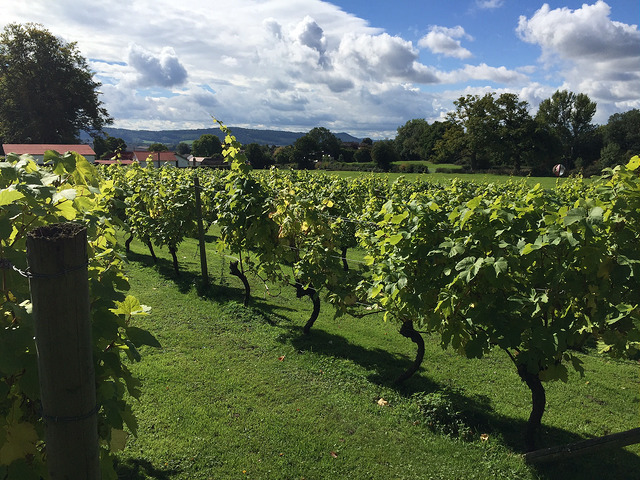
WE HEAR a lot about well established estates winning prizes – but what about the vineyards of tomorrow? I have been looking at a few ventures still at the incubation stage and they couldn’t be more different. Bride Valley is at Litton Cheney set in beautiful Dorset countryside (above). Its sparkling wine is eagerly awaited within the trade because Steven Spurrier, who owns it with his wife Bella, is globally admired as a wine expert and is taking something of a risk in suddenly deciding to practise what he preaches by establishing his own vineyard in his seventies. It is a bit like a theatre critic deciding to write their own play.
Among numerous distinctions Steven set up the Judgement of Paris in 1976 when wines from California, unexpectedly, beat top wines from France in a blind tasting dominated by French tasters but including himself. Now the taster is to be tasted – though judging by a rather delicious sample of their Classic Cuvee 2011 (almost entirely Chardonnay) I had from of the few early bottles I don’t think he has anything to worry about.
Bride Valley covers 25 acres spreading across several lovely Jurassic shale hillsides. It looks equally good in summer or in Autumnal mists when the red and yellow tints can warn vineyard manager Graham Fisher of differing soil conditions underneath or nutrient deficiencies. For instance, although the land has a chalk base similar to the terrain of Champagne country too much chalk can yellow the leaves while sudden reddish tints can indicate fractured canes. The grapes are made into wine at nearby Furleigh Estate which has won gold medals for its own wines. It is in safe hands.
JAGAJAG in Carmarthenshire, South Wales, by contrast, is a vineyard without wine. At least, not yet. It has a fully fledged infrastructure – including fine rooms and a highly regarded restaurant – but no bottles to sell. In 2013, a good year for UK grape growers, Jagajag had to abandoned its crop as the fruit wasn’t good enough. But they persevered and with a much healthier looking crop in 2014 they are hoping to have bottles ready to sell for next year. The quality of wines in Wales, led by multi-gold winning Ancre Hill Estate in Monmouth, has risen dramatically in recent years and it will be interesting to see whether Jagajag’s patience is rewarded.

Frank Myers at Wythall
WYTHALL, over the border in Herefordshire, is another contrast. It has grapes but no infrastructure from which to sell at the moment. However, if you are planning to attract visitors to a new vineyard then having a 500 year old mansion house is unlikely to prove much of a handicap. Frank Myers (above) has singlehandedly planted nearly 3,500 vines on 3.5 acres at Wythall, near Ross-on-Wye which has been owned by the family of his wife (the Euro-MP Anthea McIntyre) since the early 17th century. And they have documents to prove it.
Frank – a successful businessman in his own right – has had a dream about being involved with a vineyard ever since his childhood in the centre of Manchester where, he says, he rarely saw a tree. The main field (above) curving off to the right looks a bit like a dog leg on a golf course. He admits he may have to cut a few trees down to admit a bit more light but is pleased with this first crop which is to be turned into wine by the highly regarded Three Choirs vineyard at nearby Newent which provides an ecosystem for dozens of growers in the area. If his plans pan out and the wine is good enough this will be a lovely vineyard to visit.
EVEN smaller is the vineyard on the Sussex/Kent borders planned by Paul Olding who has served his apprenticeship on
an allotment in Lewisham, London where he has been making his own wine- up to 100 bottles of Olding Manor – for some years as a preparation to realising his and his wife’s dream of having their own vineyard. Now they have purchased land in east Sussex at Eridge Green including 1.5 acres on which they will start planting vines in 2016 after tilling the soil for a year. It will be interesting to see how this develops and one wonders how many other enthusiasts have been starting their own small vineyards up and down the country to become part of the revival of UK winemaking. Let me know . .
LAST, but certainly not least is Rathfinny which
I visited recently. Its first wine (all sparkling) is not due for a couple of years but its plan to produce a million bottles of fizz from a planned 400 acres has already sent shock waves throughout the industry. Pessimists say there is no way they will be able to sell a million bottles without disrupting the nascent UK sparkling wine industry. Optimists point out that a million bottles is barely one percent of the UK domestic fizz market and the growing quality of English wine will see off the competition and boost exports.
THESE four examples are typical of what is happening in the UK where big growers are starting to think on a global scale while boutique vineyards are happy to service very localised – but premium – markets from their cellar doors enabling them to retain the wholesale and retail profit margins.

Wythall, 500 years on

Cameron Boucher, vineyard manager at Rathfinny
The interesting fact is that well over 90% of all new plantings are of grape varieties that go to make sparkling – particularly the classic combo of Chardonnay, Pinot Noir and Pinot Meunier which is used for Champagne. I see no reason why UK wines should not go on from strength to strength. If they don’t then at least we will all be left with stocks of prize winning fizz with which to drown our sorrows.
You can receive (occasional) new blogs directly if you put your email address in the slot on the right of the screen
@BritishWino


 Posted by shakespearesmonkey


 Victor Keegan